John O'Brien's work shows us how we can help people to make a meaningful difference in their own lives.
In 2025 we lost John O'Brien. Those who knew John knew him as wonderful friend and source of love and wisdom. Others will have been influenced by John, perhaps without even knowing. because John played a critical role in developing many of the most important innovations in policy and practice of our time.
For Citizen Network he was the primary source of inspiration for everything we have done over the past 16 years. John was also our first Fellow and he continued to support our work until the very end of his life.
To honour him and his contribution to creating a world where everyone matters we are publishing a series of articles that reveal different dimensions of his work.
Author: David Towell
Working at the King's Fund, I first invited John to the UK well over 40 years ago to support our An Ordinary Life initiative, the expansion of a social movement focussed on ensuring that people with learning disabilities, like everyone else, get the opportunities and support to live fully as valued members of our communities.
John was an avid reader of the extensive literature on how social change occurs and very good at showing us the relevance of contemporary theories to our mission: achieving transformational change in people's lives. More than this he was a very skilled facilitator of conversations that matter. In this, the eleventh article in this Learning from John series, I draw out some key lessons from our work together.
There is a famous quote from Karl Marx to the effect that:
People make history but not in conditions of their own choosing.
I don't think I ever heard John quoting Marx but he certainly believed that if you bring people together under the right conditions, they can gain new insights and together achieve radical innovation. John had a deep conviction that new possibilities will emerge if we take seriously the practice of listening to, and learning with, each other. John joined us many times in local workshops and wider conferences. Often the design of these activities was informed by a large group methodology known as The World Café. This offers a simple logic:
Applied within organisations, John and his long term collaborator, Beth Mount, were both consultants to an enduring development programme described by Hanns Meissner in Creating Blue Space - 'blue space' being the environment within the service providing agency Hanns directed where disabled people, families, staff, and others could follow this logic in finding new possibilities.1 The fourth and sixth articles in this series, by Bob Tindall and Steven Rose respectively, both of whom have occupied senior management roles in similar agencies, offer important UK examples.
John was very skilful in identifying open-ended questions and simple graphics that both guide and stimulate our work together to co-produce valued change. His article (also with Beth Mount) What more is possible? introduces the spiral below as a route to helping people improve their lives. It starts from the 'five valued experiences' framework (belonging, choosing, sharing in ordinary places, contributing and being respected) described by Nan Carle in the second article.2 As Sally Warren explores in the seventh article, the gap between our visions of possibility and current experience is a strong source of motivation to do better. John and Beth identify three main areas for enhancing these experiences, expressed here as: asking more of oneself, one's supports and one's community. The spiral prompts a continuing process for seeking improvements in relation to these three areas.
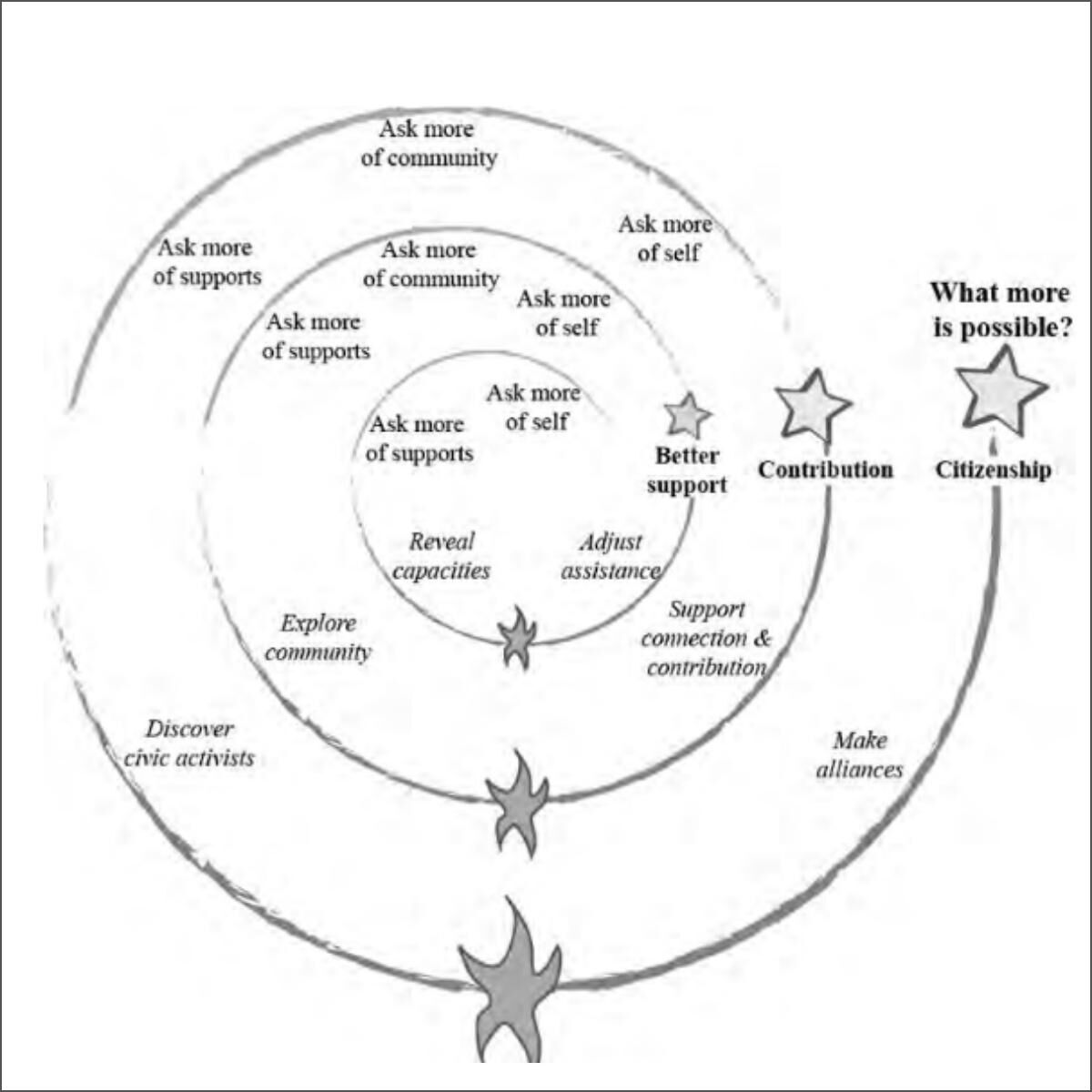
This spiral above is fundamental to person-centred planning as Gary Bourlet describes so well from his own experience in the fifth article. PCP starts from the individual and a circle of allies willing to help her/him find pathways to a better future. The ninth and tenth articles, by John Dalrymple and Frances Brown, reflect on the importance of these ideas in Scotland. Simon Duffy's article (the third) looks in more detail at ways of strengthening citizenship in more inclusive communities. This third area directs our attention to how we work together to build communities that welcome diversity, promote interdependence and recognise the assets each person potentially brings to local life.
Clearly actions around different parts of this spiral are interconnected and cumulative. I have presented the spiral in two dimensions. But helping people improve their lives requires engagement with a complex social field in which the opportunities and barriers that are close to the person are themselves shaped by, but also influence, the way larger systems impact on the small and local. A useful metaphor here can be derived from how modern ecology understands life itself: in this view, the smallest organisms in their immediate environment, the bigger systems of which they are a part.... up to the earth as a whole, constitute a multi-layered living system that has evolved in mutual interaction.
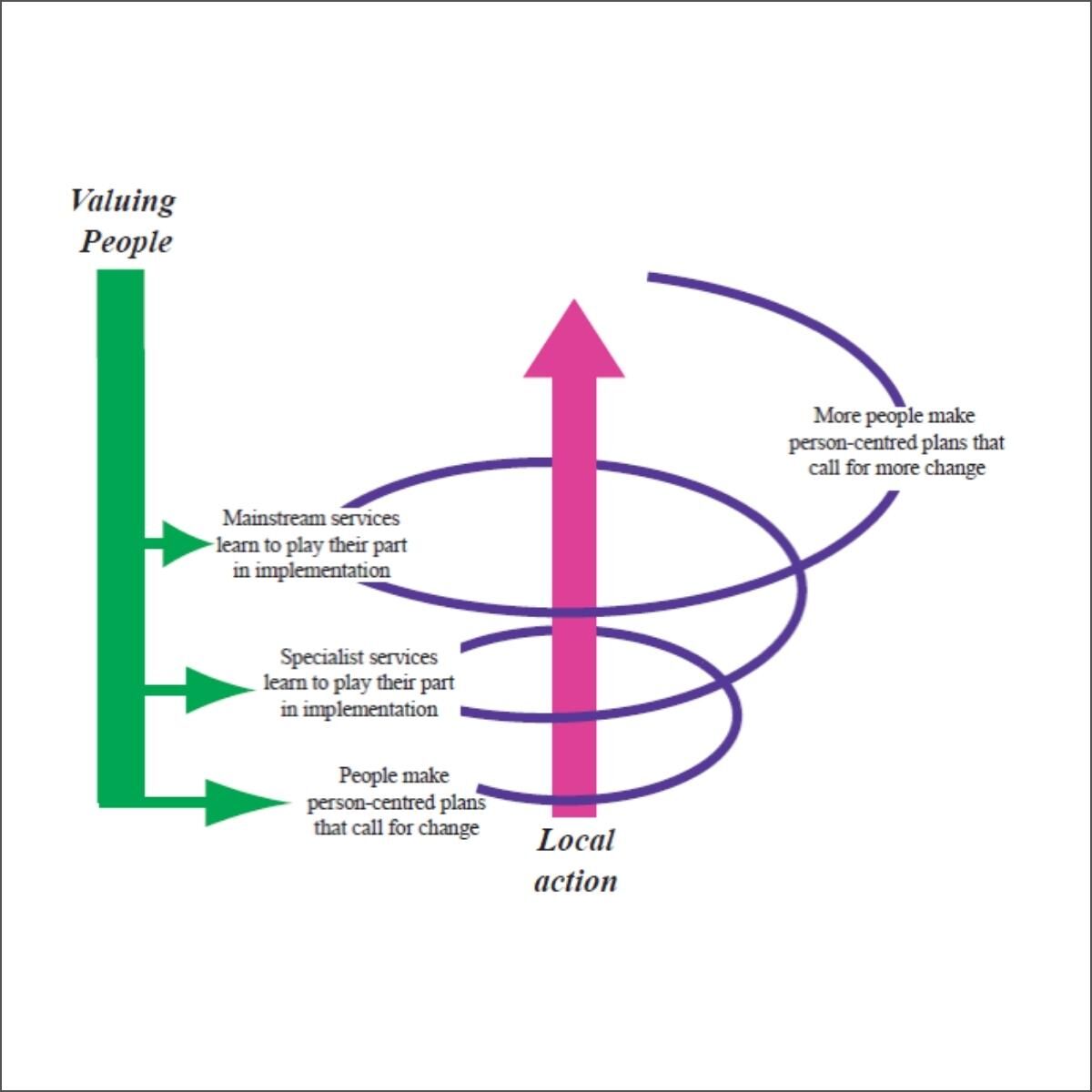
Here, above, is John's simplified representation of this idea drawn from a discussion on the conditions required to enhance the success of person centred planning, following recommendations in the 2001 government White Paper Valuing People.3
From this perspective, achieving sustainable change for individuals in their neighbourhoods, for the communities of which these neighbourhoods are a part, for people living in our towns and rural areas, and so on 'upwards', requires that we find ways of what in management jargon is described as working whole systems. Starting from the experience of individuals and, always keeping these to the fore, we need to work 'up' these layers to identify what more is possible, making the spiral three-dimensional.....or actually four-dimensional because this is an iterative process over time as people learn more about how to do better.
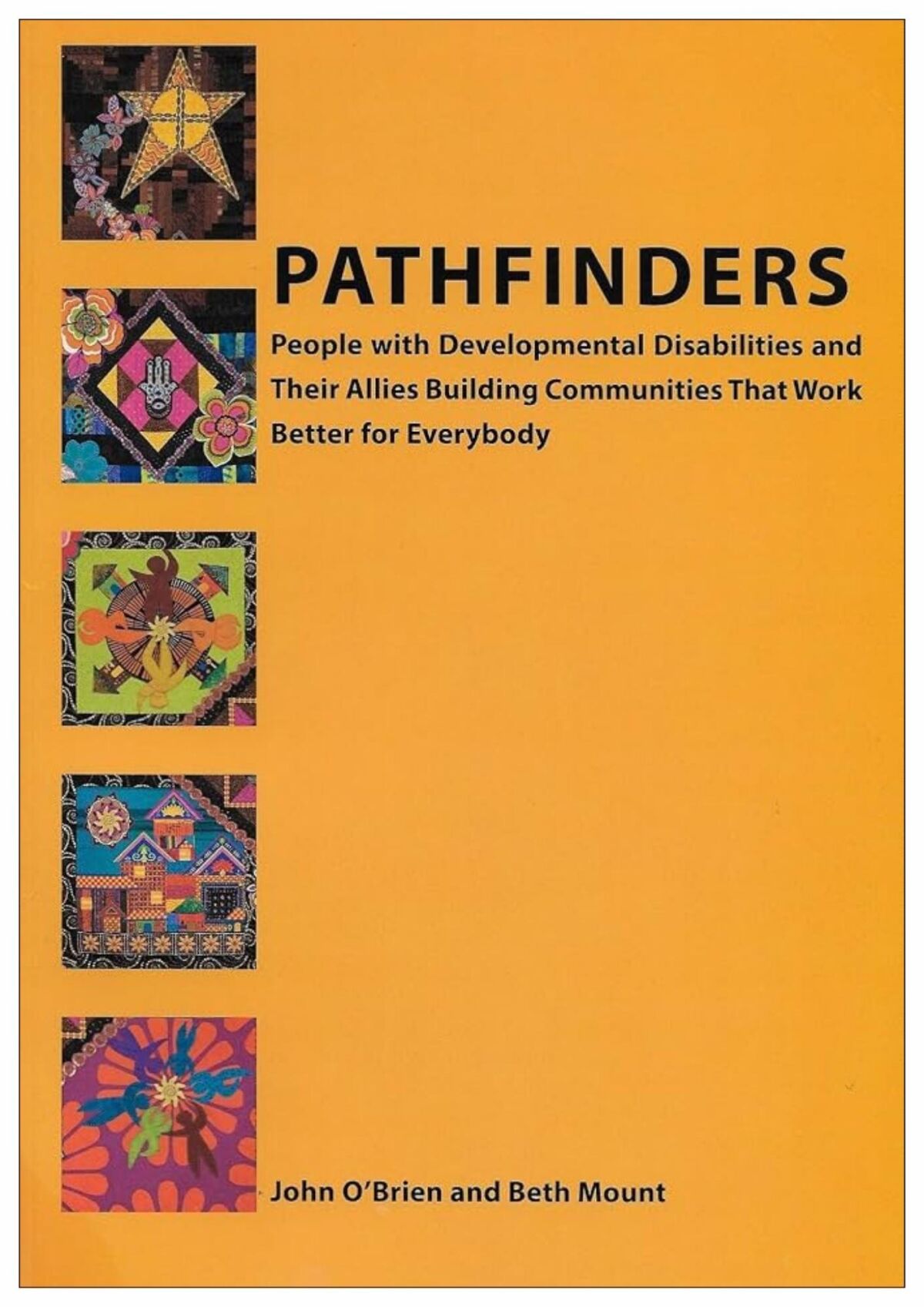
Of course, action to achieve a positive difference has to be grounded in a theory of social change. John and Beth have been important in helping us make use of the body of work known as Theory U. Indeed John wrote a very useful guide to the application of Theory U for the important cross-European change programme New Paths To Inclusion.4 He and Beth discuss in detail the application of these ideas in Pathfinders.5
This approach recognises that transformational change cannot be built on what came before through rational and incremental improvements; rather it requires that we disrupt the past in order to discover something new.
The 'U' represents the shape of this process, involving in this context:
In large systems, like a city, a region, or a country, strategic change requires that we build networks that link local efforts like these not only 'vertically' but also 'horizontally'. Vertically so that management and policy are informed by, as well as inform, very local experience, as Debra Moore describes in the eighth article. But also horizontally as we create networks in which local innovators 'share across' their learning, not to be copied but to inform innovation elsewhere. In these processes, we are also developing the capacity of more people in different roles and at different levels to exercise effective leadership.
This is precisely how the An Ordinary Life initiative grew over a decade and more to be a nationwide influence on closing institutions and enabling people, including my sister Patricia, to take their rightful place as your neighbours and mine.6 John's many contributions offer continuing inspiration for our efforts to sustain this agenda in the rest of the 2020s and beyond.
1. Hanns Meissner (with a Foreword by John O'Brien) Creating Blue Space Inclusion Press, 2013
2. John O'Brien and Beth Mount What More Is Possible? Inclusion Press, 2019
3. John O'Brien and David Towell Person Centred Planning And Transformative Change Citizen Network, republished 2026
4. John O'Brien Theory U. A Way to Change Services for People with Intellectual Disabilities Inclusion Press, 2014
5. John O'Brien and Beth Mount Pathfinders: People with developmental disabilities and their allies building communities that work better for everybody Inclusion Press, 2015
6. David Towell Towards 'An Ordinary Life': Insights from a British story of social transformation, 1980-2001 British Journal of Learning Disabilities, 2022,1-9.
You can also read more about John O'Brien and his work here.
The publisher is Citizen Network. Achieving Transformational Change © David Towell 2026
Deinstitutionalisation, Inclusion, intellectual disabilities, Canada, England, Europe, Global, Northern Ireland, Scotland, USA, Wales, Article