John O'Brien helped people to find our deeper purpose while also recognising the complexity of our shared work.
In 2025 we lost John O'Brien. Those who knew John knew him as wonderful friend and source of love and wisdom. Others will have been influenced by John, perhaps without even knowing. because John played a critical role in developing many of the most important innovations in policy and practice of our time.
For Citizen Network he was the primary source of inspiration for everything we have done over the past 16 years. John was also our first Fellow and he continued to support our work until the very end of his life.
To honour him and his contribution to creating a world where everyone matters we are publishing a series of articles that reveal different dimensions of his work.
Author: Bob Tindall
I first met John O’Brien at a 5 day event in Northumberland. It was either 1982 or 1983 – so a very long time ago. Many of us have had the longstanding benefit of both John’s interest in us and his wisdom in helping to tackle the issue we have faced. As to myself, I have had the privilege of being in senior management roles in large non-profit provider organisations for over 40 years. I talk mainly here about working in United Response from the late nineties to the middle of the last decade.
John’s presence: tall, bulky, a kind face, lively, gentle eyes. His beard became snowier with the passing of each decade. His leadership contributions to group discussions were clear and got to the heart of things. They were often laced with humour. He was fun. When he was not around, we had his writing to drop back on. The writing stays with us.
The focus of this piece is John’s impact on organisations and their development. In Pathfinders (O'Brien and Mount 2015) John, along with Beth Mount, describes their joint role as listening, and then helping people to “make sense of their situation, plan, and take action”. This was not a free ride. The steer was firm – developing and supporting “creative partnerships with people, their families and allies”. Nor was his concept of allies a narrow one. He discouraged cliques and encouraged everyone to engage with the perspective of others, no matter how frustrating or even maddening their resistance might be. I once heard him put this clearly to an audience. “Try to avoid”, he said, “regarding people as though they are evil or dumb”.
Sometimes he’d give a thought-provoking prompt. “You could try to do that” he once said to me, “but what higher purpose would it serve?”
It remains the most useful prompt I’ve ever been given.
It was a good prompt because John also fully recognized the complexity of organisational life in creating partnerships with people, their families and allies. There are many forces which bear down on organisations and many of them push away from enabling people to live their best lives. They push towards what John and Beth call “predict, standardize, produce and place” solutions rather than those designed with people, and those who love and admire them. We are all part of a perverse system which spends lots of public money to underwhelming effect
Doing the right thing is far removed from easy. John helped us look for spaces – opportunities – which would serve the “higher purpose”. Nan Carle in an earlier article has already described this – he created a way for each of us to imagine possibility. And all of this in the context of the potentially distracting obligations of recruiting and inspiring staff, balancing budgets, staying legal and satisfying regulators , commissioners and other partners
He created a framework the 5 accomplishments to act as a guide for our actions. We have also been blessed over the years with a number of other really helpful frameworks or ways of moving forward, not least Real Wealth, the REACH standards and the Gloriously Ordinary Lives’ Five Tests. Our common task, as we know, is to make them a reality.
We can’t say we don’t know what good looks like.
Making them a reality can mean choosing to be in an uncomfortable place. We can see clearly the gap between what we want to achieve and where we are at, particularly where people have a number of impairments to deal with in their lives. The realization that changing from where we are currently will definitely stretch us and will almost certainly upset people (but inspire others). That’s why looking for moments, opportunities, people, money etc to help us to push in the right direction is so important, and why John’s focus on building up networks was so precious, as is – consistently and currently – David Towell’s in the UK. Don’t mourn - organise, as someone once said.
Support workers, and their managers can often be undervalued, though not generally by people they support and their families. They can get noticed both inside and outside of organisations for not doing the right things, without having clarity on what they should be doing, the skills they need to do it and the positive recognition and reinforcement that should come with doing it right. So in addition to building up networks, John helped me and others piece together an organisational Way of Working to make clear our purpose and create the right environment and approach so that people could be properly engaged in activities which improved their quality of life.
The graphic illustration below shows how we presented this framework at United Response.
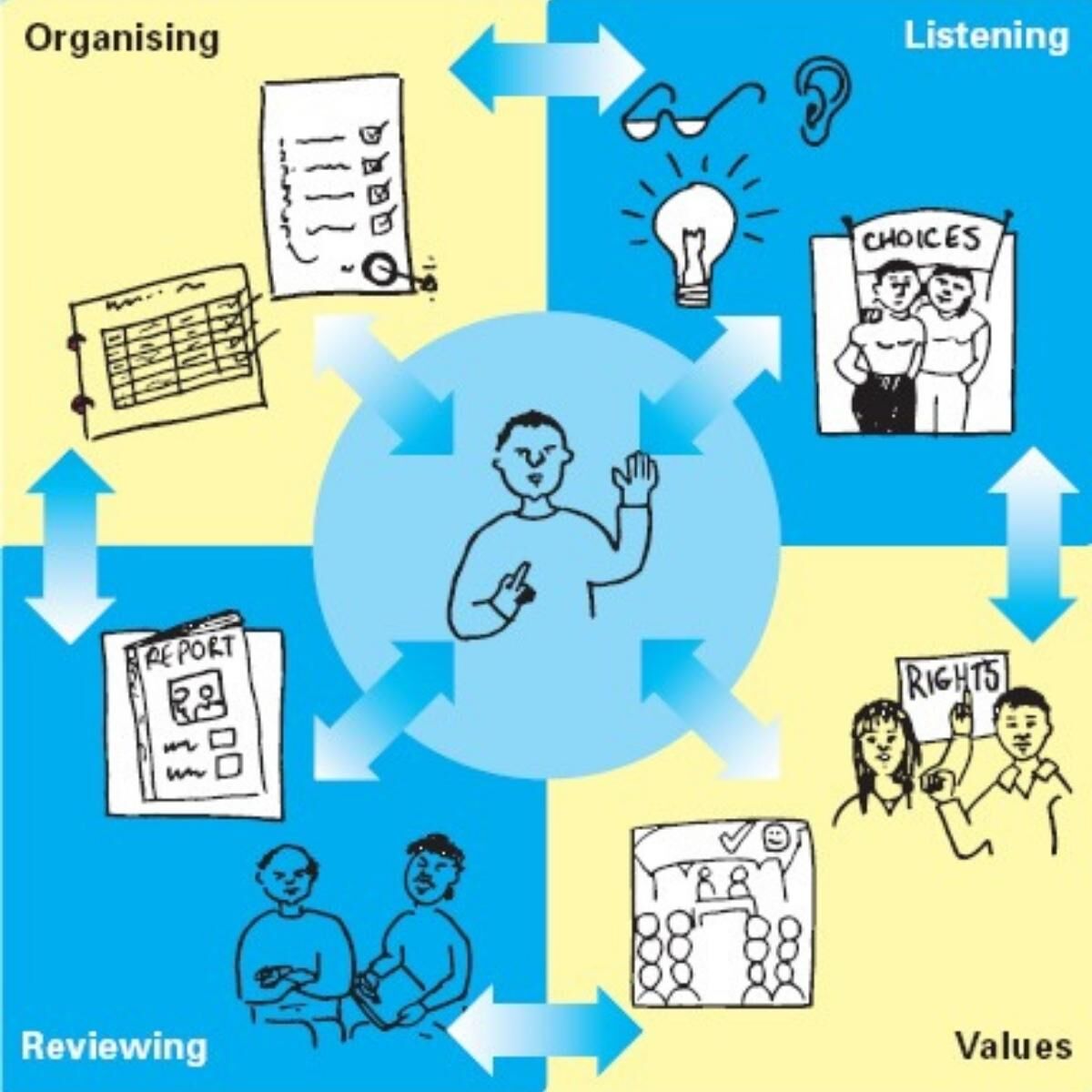
Graphic: The Way We Work
We know too well what the opposite of this approach looks like – people propped in front of large screen tvs, activities going on all around, without them being involved in any way. Person centred plans are just plans unless people and their families are engaged not only in the planning process but in the active steps which lead to real and positive changes in their lives.
This emphasis on engagement, developed by Jim Mansell as person centred active support – implemented alongside tools to help support colleagues resolve dilemmas in a respectful and positive way using the important to and important for tool developed by Helen Sanderson and Michael Smull formed the basis of cultural development. The latter tool separates out what is important to someone from what is important for them to learn and know in order to keep healthy and safe. As for all of us, getting into the thick of real life can throw up unexpected challenges. One of John’s contributions I found particularly helpful was recognizing and incorporating the thinking and contributions of others into a workable and coherent strategy for improving people’s lives
There were, of course, other things that needed to be done. John’s help was invaluable in helping us create a persuasive vision, focused on looking outwards into community life. In addition, thinking through the challenges which accompany it. Do support staff feel confident in assisting people to get to know people they haven’t met before? How well do they know the communities in which they work (but don’t necessarily live?). Are families part of this process? Do all of our multiple and frequent references to choice match the number of actual experiences that people have in order to actually make a choice in the first place? Can support staff teams working different shifts coordinate their approach to helping someone learn new skills? If they can’t, aren’t they asking the person they’re supporting to learn eight or nine different ways of approaching the same thing?
John recognized these sorts of issues (and more) as part of the turbulent but invigorating process of pursuing a better world alongside people and their families – and one that led to positive life changing experiences for people. He struck a chord because he tuned into what he called “the soul of the work” that a wide coalition of people both recognised and could respond to collectively. They are key ingredients in the pursuit of goals which serve a higher purpose
Reference
O'Brien J and Mount B (2015) Pathfinders – People with Developmental Disabilities and Their Allies Building Communities That Work Better for Everybody. Inclusion Press.
You can also read more about John O'Brien and his work here.
The publisher is Citizen Network. A Higher Purpose © Bob Tindall 2026.
Deinstitutionalisation, Inclusion, intellectual disabilities, Canada, England, Europe, Global, Northern Ireland, Scotland, USA, Wales, Article