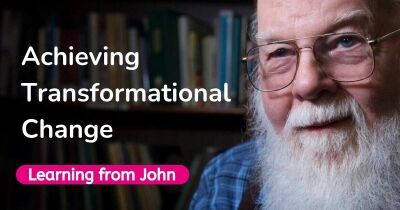
John O'Brien always respected those who provided direct support and the value of those relationships.

In 2025 we lost John O'Brien. Those who knew John knew him as wonderful friend and source of love and wisdom. Others will have been influenced by John, perhaps without even knowing. because John played a critical role in developing many of the most important innovations in policy and practice of our time.
For Citizen Network he was the primary source of inspiration for everything we have done over the past 16 years. John was also our first Fellow and he continued to support our work until the very end of his life.
To honour him and his contribution to creating a world where everyone matters we are publishing a series of articles that reveal different dimensions of his work.
Author: Sally Warren
When I heard about John’s death in June, I naturally started thinking about how John’s wisdom and gentle support shaped my work at Paradigm. And actually, how his quiet wisdom still shapes our work at Paradigm today.
It all began in 2012. I had been the Managing Director at Paradigm for a few years and I had begun to feel disheartened. I was struggling with how much of Social Care was so dominated by standardised systems, regulations and homogenised group thinking.
Too many people with a learning disability seemed to be getting lost in the system even though it was a time when there was an enormous investment in “person-centred practice” training.
People who received paid support, and the support staff alongside them, told us they felt tied up in red tape and deeply frustrated. It felt as if Social Care was getting in the way of good lives rather than enabling them.
At a low point, I was questioning whether our work at Paradigm was truly making a difference or just reinforcing the very systems we hoped to change. David Towell, a critical friend, suggested I speak with John O’Brien.
John’s work and thinking had inspired me for decades. He championed a simple but powerful truth: relationships are the beating heart of supporting people to live good lives, and of life itself.
I plucked up the courage to speak to John and of course, I needn’t have worried. He listened to my heart-felt ramblings. He listened in what was his usual thoughtful way.
To my surprise, he offered to co-host a workshop called ‘Re-connecting Hearts and Minds’. People with learning disabilities, family members, commissioners, campaigners, support workers, and managers from provider organisations were invited to take part in the workshop.
The guiding question we explored together was:
‘What threatens an organisation’s ability to support relationships that connect the heart and the mind?’
John created a space where reflection felt natural, honesty felt safe, and brave truths were talked about. The room hummed with possibility. We felt our heads and hearts finding each other again and fired up for action! The workshop reminded us that it is relationships, not systems that spark real change and keep possibilities alive, particularly the role of support workers in people’s lives. These relationships can either open doors to possibility or, when limited by unwillingness, rules and routines, quietly close them.
As John later wrote:
‘At the core, trust grows when support workers act from a wholehearted effort to see the whole person as the person is and potentially can become...’
John O’Brien, Re-connecting Hearts and Minds (2012)
That workshop was one of the powerful moments in my working life. It reignited my passion. It gave me the courage and reminded me to look again at what really matters and to make sure that any work we did had to focus on human connection, discovery and people being seen and valued.
‘Many laws and policies have not caught up with the ideas that people should be able to lead an ordinary life with the support they need and that people themselves should be in charge of decision-making about their lives.’
John O’Brien, Healing Integrity Gaps (2013)
John stayed in contact with us, and at another workshop we explored the idea of the ‘Integrity Gap’ - the space between what we say and what we do. Integrity isn’t about being perfect. It is about being willing to notice, to pause, to question and to change.
Sometimes this gap is subtle but profound. We can speak passionately about person-centred practice but do an organisation’s rules, in reality, limit people’s choice and freedom?
We used this story to start the conversation:
‘A support worker once told me …‘I was proud of myself yesterday. I arrived and saw Robert sobbing. I knew his mum had died the day before and wanted to hug him, but I didn’t as I know we are not allowed to hug the clients.’
This story and others revealed painful truths about how systems were eroding the simple act of seeing people as humans with very human needs.
What was very beautiful was that John’s way of teaching was never about blame. Instead, he invited us to notice these gaps gently and ask with curiosity, ‘Why does this happen?’ and ‘What might help us close the gap.’
‘Positive cultures can thrive if people discover a better way, support each other to risk it, and create space for freedom to grow.’
John O’Brien, Creating Positive Cultures (2016)
Because of John, Paradigm’s work held tight to the power of honest, thoughtful, sometimes uncomfortable conversations - conversations that cut through to what is important. Such conversations inspired us to reshape the Reach Standards (a set of voluntary standards that introduce the fundamental principles of supported living) for the future: “What does good look like here, and how can we make it real?’
He taught us that sustaining a positive culture relies on:
John O’Brien’s death in June 2025 is a huge loss. We are reminded of him every time:
‘It will be frustrating; we will feel limited and fallible. But if we are aligned with people’s deepest desires and highest potential, we will keep going.’
John O’Brien, Creating Positive Cultures (2016)
I hope this article will itself act as an invitation to every reader to both reflect and act on how we can bring John's important messages to life in our everyday contributions.
John is at the heart of everything we do, even to this very day as we co-produce A Guide to Being a Great Support Worker, a resource to capture the heart of support work, and the deep human connection it requires. Thank you, John for being you.
You can also read more about John O'Brien and his work here.
The publisher is Citizen Network. The Importance of Relationships © Sally Warren 2026.
Deinstitutionalisation, Inclusion, intellectual disabilities, Canada, England, Europe, Global, Northern Ireland, Scotland, USA, Wales, Article