Schools are failing young people, Hilary Cremin draws on the ecological principles of rewilding to sketch a solution.
Review of Rewinding Education by Hilary Cremin
Reviewed by David Towell
Professor Hilary Cremin is head of the Faculty of Education at Cambridge University. She is a teacher who teaches (she would say, helps to educate) teachers and would-be teachers. She has extensive experience in the UK and has worked in other countries, mostly in the global South. From this privileged vantage point, she writes to young people at the end of this book that ‘most schools are pretty awful places most of the time’.
In Rewilding Education, she develops this critique, starts to spell out a bold vision of what would be better and illustrates this vision with concrete descriptions of notional days in the everyday life of some innovative schools in different social contexts.
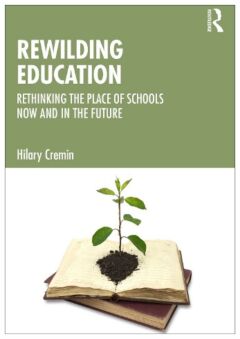
As the book title implies, Cremin draws on rewilding, a concept from ecology, to provide an organising metaphor for the process of educational transformation she commends. In agriculture, this means reassembling ecosystems that allow natural interactions rather than human interference to steer their environmental trajectories.1 Cremin certainly sees the importance of both respecting and engaging with nature as part of all our learning. She is also keen that educational experience should have features that are wilder, more varied, more emergent than the standardised and knowledge-focused practice that characterises typical schooling. Beyond this, I didn't find the metaphor very illuminating: I am not sure what previous uncultivated state we might want to restore in education!
Cremin develops her argument with particular attention to four overlapping themes that in their positive forms offer the pillars for education system redesign.
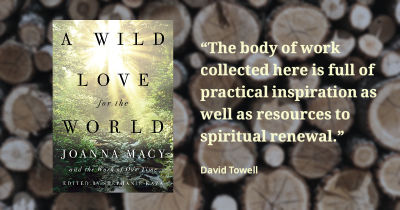
First, Cremin is concerned that much current education is failing to engage fully with THE existential crisis of our times, the climate emergency and its impact on biodiversity - more simply, life in all its forms. She sees the long shadow of modernity encouraging the attitude that humanity has mastery over nature and can always find technical solutions to physical challenges. Rather her first pillar is to base education on the idea that we are part of nature and can learn from what it teaches about living in harmony with what is around us. Being ecocentric, not egocentric. This understanding is more likely if schooling makes time and space for experiencing and reflecting on nature first hand, well illustrated in the case studies of a Montessori Forest School in Germany and the Rishi Valley School in India, both located in the wild. I am reminded of Joanna Macy's A Wild Love for the World. 2
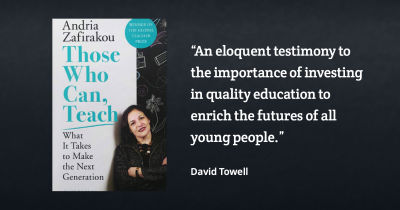
Second, there is the need to rethink what we mean by wisdom. Much education is dominated by the acquisition of (examinable) knowledge. A more holistic philosophy of education would seek to integrate modern science and ancient wisdom to promote a pattern of learning that attends to 'body, heart, mind and soul'. This will often involve project-based learning in which the teacher/facilitator helps students draw out learning on these dimensions from the project experience. Like Andria Zafirakou, Cremin also foregrounds the importance of encouraging creativity in education and the importance of the arts in all their variety.3
Third, Cremin notes the poor health that impacts schools, not just among students but also teachers. In the UK we have an epidemic of childhood obesity; a lot of schools sold their playing fields. Self-harm is another epidemic. Teachers complain of stress and depression. We need instead to shape educational experiences that empower student choices, develop relevant practical wisdom and encourage compassion. Two contrasting examples are offered here. The Carr Manor Community School in Leeds makes extensive use of circle methodology, a simple way of creating a space in which participants can engage as individuals on an equal basis with others to share their ideas and feelings.4 These experiences are building the school community. Barefoot College International trains women in 'poor' areas as solar engineers so that they can make valued contributions to their local economies. They are building 'communities of practice' that sustain the women in these important roles.
Fourth, Inequality. Despite claims to the contrary, Cremin sees little evidence that in the UK, the education system is reducing inequality. Rather the opposite, like Michael Sandel's observations on the USA, it is more that implicit ideas about meritocracy mean that schools mostly act like sorting devices that sustain inequality.5 Interestingly here, the main case study is about the Indian state of Kerala as a whole whose left-oriented governments seem to pursue many of the principles of the Doughnut Economy.6 The challenging message here is that many aspects of education are reflections of power structures in the wider society. A big question then is about how far schools can sustain a space for critical reflection on these wider dynamics or indeed equip students to lead the revolutions we need.
Cremin stops short of answering this question or indeed offering a view on how these four pillars might be operationalised in a programme of educational reform. Rather than a conclusion, she writes four letters to stakeholders in the education sector (policy makers, teachers, parents and young people) inviting their participation in continuing this conversation...and taking action in a spirit of hope.
References:
1. Jepson P. and Blythe C. Rewilding: The Radical New Science of Ecological Recovery. MIT Press, 2022
2. Stephanie Kaza (ed.) A Wild Love for the World. Sambhala, 2020
3. Zafirakou A. Those Who Can, Teach. Bloomsbury, 2021
4. Baldwin C. & Linnea A. The Circle Way: A leader in every chair. Berrett-Koehler, 2010
5. Sandel M. The Tyranny of Merit. What's Become of the Common Good? Penguin, 2021
6. Raworth, K. Doughnut Economics: Seven ways to think like a 21st Century economist. Random House, 2017
The publisher is Routledge. Rewilding Education © 2025 Hilary Cremin
Rewilding Education Review © David Towell 2026
education, Sustainability, England, Northern Ireland, Scotland, Wales, Reviews