Individuals from all over the UK came together to develop an initial Charter for radical democratic reform.
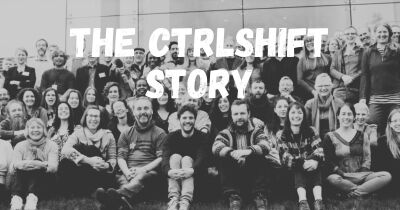
On 2 December 2025, 21 people from different grassroots community groups from different parts of the UK met to explore the development of a new charter of demands to reform our broken politics. The group was convened by Citizen Network and Control Shift and was ably supported by Our House.
During the day the following 6 demands were developed:
Co-authors of the charter were:
Lachlan Ayles, Gavin Barker, Tom Brake, Coco Cherian, Sue Cooper, Billy Dasein, Simon Duffy, Clare Hearne, Gill Hughes, Hilary Jennings, Mara Livermore, Carolina De Oliveira, Kate Macdonald, Katy Rubin, Amber Ruttley, Simon Sherbersky, Michael Thomas, Nathaniel Whitestone, Oli Whittington and two people who preferred to be anonymous.
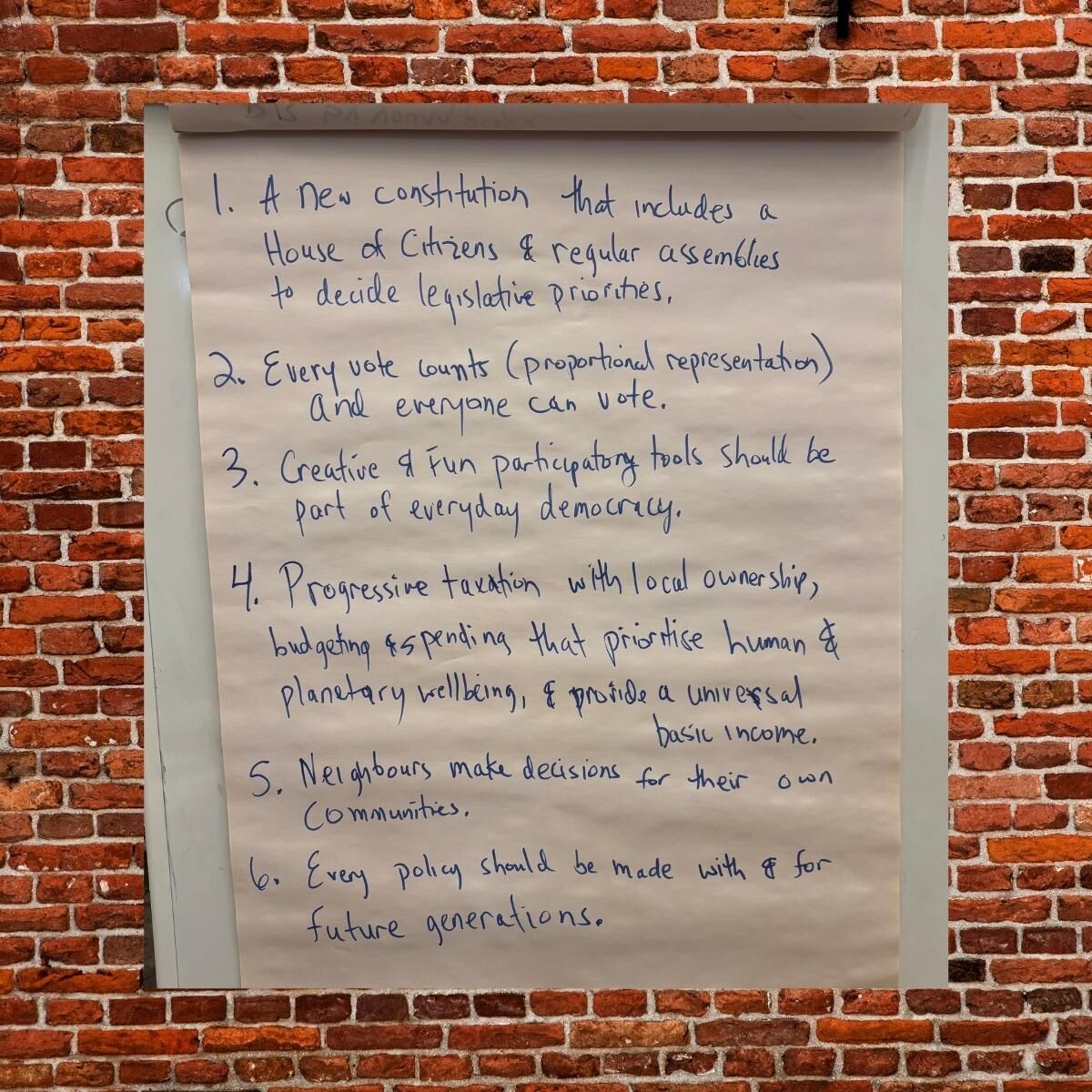
Photo: A new charter
I was chuffed that such a great group of people made their way to Sheffield from all parts of the UK. We covered a lot of ground and I know that different elements of the charter appealed to different people in different ways. Nevertheless I think there was a strong sense that something like this set of demands was the right way forward for our democracy.
These are some of the other questions I was left with. These are only personal reflections and don’t necessarily reflect the views of anyone else:
1. The idea of developing a Charter is based on the historical experience of the Chartism which was a very active force for reform and even rebellion in the early 19th Century. The original Charter had 6 very clear demands. But is 6 the right number for our times?
2. Our new Charter includes themes and ideas that seem strong and relevant. However, some of it isn’t as clear, crisp or as strong as we might want. The work of Our House will hopefully lead to more such Charters being developed and compiled. How could we involve a wider group to improve them? Perhaps Citizen Network and allies could design a campaign to let more people have an input into this process.
3. There was a strong sense that we had not really done justice to the rights of nature and all the different living things.
4. Before and after the event I’ve found that not everyone agreed that the Charter should include socio-economic reforms (ie. taxation, basic income, local ownership, local spending etc.). Personally I am a strong advocate for including such reforms; in fact, I would argue that historically democracy has always been about protecting such rights (e.g. read Aristotle on the birth of Athenian democracy). However, others argue that more purely procedural notions of democracy would win public or political support more easily. Is that true? I don’t know. How could we test that out?
Just some musings on these points, which are crucial to build an alliance for change.
Points 1 and 2 and 4 link - 1. is 6 enough could be determined by answering 2. questions on involving a wider group ie engaging with others to improve/add/amend and 4. testing out propositions.
This could be developed as a campaign as suggested and if the material is engaging it can do a lot of the work but there is a need for targeted engagement - some are obvious ones that we all know:
1. Could those involved send this version of the charter out to their own networks and ask co-ordinators to engage with their members?
2. Perhaps we could work with community centres networks to reach grassroots communities. e.g. put a flip chart up with the 6 points on and share campaign material to ask people what they think; engage in conversations ask people what would they support and what is missing; collect post-its or for those with access to smart phones a QR code to collate feedback.
3. Create a kit to take to different events [e.g. flip chart and post-its/QR]
4. Go to where people are at shops, stalls at events etc. As local allies build there will be more people to help with engagement to gain support for a charter.
Such work can generate conversations about rights and democracy and need for a charter but in current circumstances also encourage engagement to counter the rise of the far-right and the low voter turnout in many areas.
This work offers space to create conversations that counter myths and weave connectedness across divides. Be curious about the stories of others and explore the common ground in the issues raised to ensure that this is not about blaming 'the other' but is about rights that need to be fought for to build solidarity and unity to gain the charter and create systems change.
Citizen Network has published this Charter in the hope that this will spark more action and thinking about these things. It is interesting that people particularly stressed the rights of ordinary citizens in their own communities. At the very least we hope this encourages democracy activists to remember that democracy is not just about how we make decisions—it is also about who makes the decisions.
Basic Income, Constitutional Reform, local government, Neighbourhood Democracy, politics, England, Northern Ireland, Scotland, Wales, Article