The results of the first survey to establish who should receive a basic income are in.
Author: Daniel Mermelstein
Those of us who campaign for a Universal Basic Income (UBI) often have to deal with an objection that feels particularly ingrained in people's minds: that there are groups of people who are less "deserving" of money than others.
This objection normally takes concrete shape in some idea of a layabout on benefits, who is just "sponging" off the "system". But from there it is easy to generalise towards other groups for other reasons, for example artists, who obviously smoke a lot of pot and never do a day's work; or immigrants, who haven't "paid their dues" and now want to take benefits.
But a UBI is a bit of an "all or nothing" proposition. It is a small but periodic (weekly or monthly) payment, made to every eligible individual in society, without any conditions whatsoever (no means test or work requirements). So either everyone gets it, or it isn't a UBI at all. It may be a good idea to give extra money to a particular group, for whatever reason, but that cannot be accurately called a Basic Income.
There are many reasons why we all experience this reflexive desire to divide the world into "deserving" and "undeserving". It may be what we read in the press, or what we hear from politicians, or what we experience in our lives. But how deep does it run, this reflex?
Often, when we have more time to explain or to probe, when we set out particular examples of groups of people and why they may benefit from and "deserve" a Basic Income, we see a change in perception, a willingness to listen and to think more deeply. Because a "benefit sponger" is a mental construct, but we all probably know someone who is caring for elderly or disabled relatives; or someone who lost their job because technology changed and left them behind; or someone whose disability does not allow them to work as much as they'd like.
So then a small opening is created, where our natural human empathy is awakened and perhaps it can be extended beyond what we know, or think we know, towards a wider circle of interest and concern.
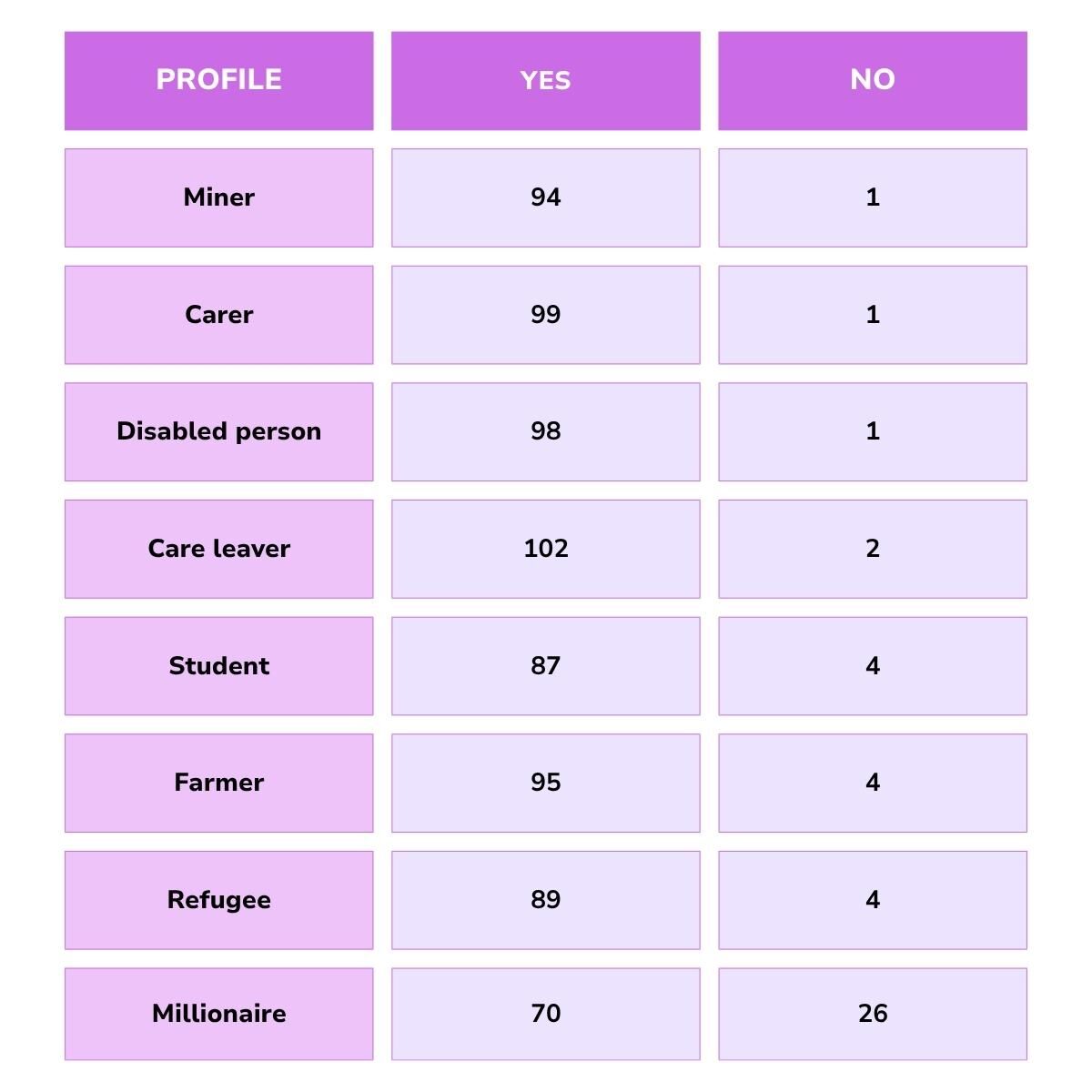
We think that the empathy reflex is more powerful than the "deservingness" reflex. And to test that hypothesis we came up with a short survey. It sets out a number of profiles of different people (fictitious, but based on real people) and makes a case for why they should get a Basic Income. And you can vote yay or nay. It is not some statistically accurate or totally impartial survey. But it is the start of a conversation.
Here are the initial 100+ responses to the quiz:
For those of us who campaign for it, a UBI is not a benefit, but a right of citizenship, an acknowledgement that everyone is due, by right, a part of the historic and current wealth that our ancestors created and we continue to create. That just by being here everyone is making a contribution, in whatever way they want to make it. It is a statement that we are all in this together and that there are no "in" groups and "out" groups, no "deserving" and "undeserving". But this is an argument that has to be made. And this survey and the conversations it generates is an attempt to make that argument.
Do you want to join us in this conversation?
Would your campaign benefit from a call for universal cash?
And is your network in favour of it?
If you would like to distribute this survey among your network, please get in touch with us — we can create a campaign for you and share the results as they come in (follow the link to my email address in my profile below).
The publisher is Citizen Network. Who Should have a Basic Income? © Daniel Mermelstein 2026.
Basic Income, social justice, tax and benefits, England, Northern Ireland, Scotland, Wales, Article