A progressive vision of Universal Basic Income, that's sustainable, effective and empowers the many not the few.
Author: Yuvan Kumar
Universal Basic Income (UBI) refers to a government funded payment to all members of a population ensuring every individual has a minimum level of income. Unlike other welfare programmes, UBI is not means tested, nor is it contingent on any behaviour.
In the UK, people in vulnerable circumstances currently face an over-bureaucratised complex network of benefits. Not only does this reduce the dignity of individuals without sufficient income to support themselves, but it leads to poverty and unemployment traps. Individuals are also punished for saving, living with others or for pursuing activities outside of traditional paid employment.
UBI has enjoyed support from a wide range of viewpoints, conservatives who seek to reduce the role of the state and streamline the benefits system and progressives who see UBI as a method to maximise the living standards of the least well off in our societies. However there remain crucial differences over how UBI should be structured and how we should pay for it.
In this essay I propose a progressive vision of a UBI for the twenty first century; one that is sustainable, effective and empowers the many not the few. My analysis begins from two basic principles:
In line with these two principles, this essay will put forward the case for a UBI funded by socialising the proceeds of economic rent. This develops the idea of economic rent advanced by Henry George. George argued that where naturally or socially created value is privately gained, justice requires the proceeds to be socialised.
The aim of this essay is to construct a case for UBI which appeals across the political spectrum, through moral and economic arguments.
UBI schemes do not require the most vulnerable in our society be assessed by bureaucrats trying to distinguish the deserving from the undeserving poor.
Such decisions are made on arbitrary grounds, and they render those who are on low income - because they seemingly didn’t ‘try hard enough’ - financially deprived and socially humiliated. The simple fact is that success in the market economy is largely dependent on factors outside
one’s own control. Thus, for many it seems intuitively unjust to leave people to suffer at the whims of the market like this, and it is therefore the role of the state to ensure that everyone is provided a basic means from which they are able to lead a life they have reason to value.
The unconditionality element of a UBI might be best explained through its parallel with our NHS. The health service is free at the point of use for everybody without regard given to how or why your illness arose. Likewise, an unconditional income operates on the same principle that regardless of one’s own decisions, everyone is entitled to the same basic income. Ultimately, it is not the role of the state to be the moral judge of our actions and given this is already accepted in the NHS, it could also be accepted in our welfare system.
David Graeber supported UBI on the grounds that modern capitalism had abandoned efficiency and created millions of worthless and meaningless jobs in the process.1 Thirty-seven percent of the British workforce believed that their jobs fitted Graeber’s description of ‘bullshit jobs’ of having no purpose or adding no value to society.2 Not only are such jobs useless, and sometimes harmful to society, but they negatively affect the people who do them. Individuals in such jobs are less happy, more stressed and more anxious.
If we wish for human happiness, we must abandon the idea of working for the sake of work. Work, in the economic sense, is not inherently good. It is only a means to an end of human happiness and human flourishing. This is especially true in our current labour market which is saturated by meaningless and tiresome office jobs.
Caring for somebody, looking after your children, painting or creating music are not considered work unless you are paid to do it by someone else. Yet these are the very activities which make life meaningful for so many. Despite this, progressives still focus obsessively on full employment as a measure of economic and social success, when unpaid work can be far more useful, meaningful and enriching.
A UBI would give people enough security to work fewer hours and spend more time on the activities that matter most to them and to society. This is evidenced as participants in the Finnish pilot reported “a perception of better mental and economic wellbeing”.3
We entrust political power to representatives because we ordinary citizens lack the time to govern directly. If we as citizens become inattentive though, those in power may begin to act in their own interests rather than the public good. Thus, the foundation of any healthy democracy is an informed and politically active citizenry.
Currently the largest constraint on citizens being informed and politically active is their time spent working to earn a living. This is unfortunately especially true among those living in poverty and insecurity who may not have the time to be politically active, meaning their voices are not heard, nor are their interests promoted by those in power.
A UBI could help in this regard by giving everyone a basic level of security and allowing them more time therefore to make themselves informed and active citizens. This would help democracy retreat from the ills associated with a disengaged and apathetic citizenry. This is particularly pertinent to the modern age of democratic crisis as both technocrats and populists have disempowered ordinary people from decision making processes hollowing out the public square.
Giving people money is superior to giving them benefits ‘in kind’.
In economic terms, for those who would spend extra income on necessities, they can continue to do so with UBI meaning it is just as useful as ‘in-kind’ benefits. However, for those who assess that more utility is derived from spending extra income on non-essentials, they would benefit from a UBI over an ‘in-kind’ system as the UBI gives them freedom to choose. In this way UBI avoids the paternalist approach of telling people what to spend their money on. It realises that individuals are responsible agents capable of choosing what is best for them. However, people who are in favour of giving people in poverty vouchers are often against basic income proposals. They seem to think that such people will spend recklessly on demerit goods. However, the evidence points to a different conclusion; when people have security and stability, they are less likely to spend on ‘harm’ goods such as cigarettes or alcohol which are often used as ways to cope with economic precarity. In Kenya, a UBI pilot did not increase spending on alcohol or tobacco but increased incomes and enterprise.4 Yet it remains that people can still be irrational, impulsive and irresponsible with their UBI. Despite this, treating people like responsible agents, even if they may not always act in alignment with such expectations is conducive to a healthier democratic society and a society where we respect the rights and dignity of people to choose for themselves.
The autonomy and freedom of the individual are a key part of UBI’s appeal; however, this does not mean it should be confused with a libertarian philosophy. UBI should not stop at income security for all but should and does promote the importance of public services.5
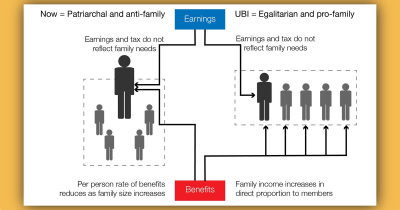
Additionally, unlike current benefits and proposals like Friedman’s ‘Negative Income Tax’, UBI is delivered at the individual not household level. This is an important distinction with implications for freedom. It means that unhappy partners no longer feel the need to stay in relationships for the sake of financial security. Additionally, it gives the individual the positive liberty to form families, no longer worried about losing benefits if they start to share accommodation with another person as is the case currently.
So far, we have constructed the case for why we need a progressive UBI. It will make our welfare systems more efficient and give people the dignity and freedom to live happy, fulfilling and civically active lives. I will now set forward the complexities surrounding implementation, before introducing a just and effective funding strategy which meets my two principles.
Some models may show that UBI, implemented in certain ways, could make the people on very low incomes worse off.6 Therefore, it is imperative for policymakers to ensure UBI is financed and implemented properly to meet my first principle that a UBI will only be worthwhile if it makes the least well off, in terms of income and security, better off.
Most schemes are of course progressive on aggregate, but as evidenced by microsimulations, such schemes can simultaneously negatively affect the income of the least well off. The main issues surround financing payments through payroll taxes, setting payments too low and not adequately compensating those who would lose some of their existing welfare payments.7
If a UBI were to replace all current benefits, many individuals who receive welfare payments could become worse off. This is why a progressive UBI needs to be high enough and be progressively funded so those who would stand to lose substantial welfare payments are not left worse off. This has led to misguided and unfounded criticisms that an affordable UBI would be pointless and a UBI worth doing would be too expensive; such myths will be dispelled in the subsequent section on funding.
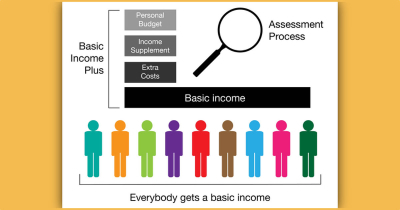
Crucially, to comply with my first principle, disabled individuals will be entitled to extra support. Disabled individuals already receive extra support, on a capabilities-based approach with Personal Independence Payments, because of the higher living costs they face. People will be able to keep their UBI whilst they seek additional support based on their needs. In this way, security and dignity are maintained.8
A UBI that was high enough to enable people to refuse low pay, or very insecure work would increase the bargaining power of low-income workers, causing wages to rise. But if the UBI was not high enough to enable people to refuse ‘bad’ jobs, it would have the opposite effect and it may act as a wage subsidy with employers capturing some of the gains through lower wage growth, producing distributive outcomes quite different from those originally intended. Therefore, it is again imperative that a progressive UBI is set at a high enough level, and that the state also maintains labour protection laws.
For a UBI scheme to meet my first principle, I argue that funding patterns should follow my second principle that a UBI is justified as a transfer from where value created by many is gained by the few.
John Rawls famously objected to a basic income on the grounds that it would allow some people to spend their lives “surfing on the beaches of Malibu”.9 The objection is powerful because it appeals to a basic intuition about fairness: why should people who do not work receive an income from those who do?
One could respond by rejecting the premise of this argument. Most people do not want a life of idleness, and it is a misguided conception of human nature that drives such questions. But if we accept Rawls’s concern, we must explain if and why citizens have a claim to a basic income even when they are not currently contributing through paid work.
The answer is yes, but only if the UBI is funded in the right way.
A UBI funded through economic rents would be a social dividend by returning to all citizens from forms of wealth that are created collectively or naturally but captured privately. In this way benefits that previously accrued only to the few are opened to all.
Georgist theory argues that economic rent can be defined as yields that flow privately but are created socially or naturally (meaning that they are present independent of human labour). Examples include landowners who receive rising land values created by public infrastructure and the wider community, and increasingly digital platforms who extract rent through control of access to data, attention, networks and online markets.
In these cases, private income depends on value created naturally or by society. Therefore, it is not earned by an individual.
The moral case for a rent-funded UBI is therefore straightforward. If part of modern wealth is created collectively or naturally, then all citizens, regardless of if they work or not, have a claim to part of that wealth. A UBI funded by economic rents returns socially created value to the society that helped create it.
This is a broad understanding of economic rent and in the subsequent sections I will highlight the extreme scale at which this form of rent exists in the modern economy, and the potential mechanisms by which it can be socialised.
Additionally, as Mazzucato has pointed out, the extraction of rents is also harmful economically. When firms pay high land rents, monopoly prices, licensing fees or platform charges, those costs are passed on to consumers through higher prices or to stakeholders through lower wages, lower investment, and reduced profits for genuinely productive firms. Rentier income therefore has distributional and efficiency costs. It enriches those who control scarce assets while weakening the incentives of those engaged in productive activity as those who add the greatest value are rewarded an increasingly diminished share. As a result, a growing body of research suggests that an increase in rents is a major contributor to increased inequality, less vibrant entrepreneurial ecosystems, and lower levels of productivity growth and investment in modern economies. So, capturing this rentier income could have significant benefits through higher innovation, productivity, wages and living standards.10
In many cases, rent extraction is not even a natural market outcome but the result of political and legal choices. Government policy on planning, business rates, intellectual property and stock buyback and financial regulation has created fertile ground for rent extraction.
Eliminating rent extraction altogether would be practically impossible. The aim, therefore, should not be to abolish all rents, but to socialise a significant share of them. Where rents arise from socially or naturally created value the public should receive a dividend.
For these reasons, a UBI funded through economic rents is both morally justified and economically practical. It answers Rawls’s objection by changing the source of the income. They are receiving a share of the common wealth; namely the land, knowledge, institutions, infrastructure, data and public investments that no individual created alone. Crucially, as long as the level of UBI is large enough, it would be in line with my principle that UBI will only be worthwhile if it makes the least well off, in terms of income and security, better off; due to the economically progressive nature of socialising rents.
One could also consider high earners to be accruing an economic rent from their natural talents and their benefitting from socially created value. Drawing on the arguments of Sandel: consider the footballer Harry Kane; his natural talents were cultivated through taxpayer funded public infrastructure and coaching at school and club level before he went on to be one of England’s top players. He has therefore benefitted from socially created value as he would never have been a footballing success without the right infrastructure around him. In this way, taxing income is justified as a way of returning to society a portion of the income he has received because of socially created value. I do appreciate however that this is a harder and less appealing argument to make in favour of a UBI as taxes on income to fund a UBI could be unpopular, lead to resentments, and can also distort incentives for productive activity in the economy. Thus, income taxes could be justified to fund a UBI, but they should only ever be used alongside rent socialisation. Also, it is worth considering the fact that increasingly fewer people will be working conventional jobs in the near future as a result of Artificial Intelligence (AI), so funding should be focussed on where the most wealth will be.11
Estimates suggest that the net cost of a progressive UBI would be in the region of £67 billion per year.12 This figure could easily be reached through rent socialisation and the removal of unnecessary government spending including subsidies. Rent socialisation has not been done on this scale before, as such funding channels may take time to begin operating and implementation may need to be gradual. This however does not constitute an excuse to postpone a UBI scheme. Simply removing corporate welfare (which in 2015 sat at £93bn) would go a long way in funding.13
The oldest form of rent is from land values. Drawing on Ricardian and Georgist arguments, Greater London Authority's Planning Committee have detailed how a Land Value Tax could replace our current taxation of land/ housing by removing business rates, council tax and stamp duty.14 Our current system is both regressive due to outdated council tax bands and has contributed to our current housing shortage by incentivising landowners to leave sites derelict to avoid business rates and to passively benefit from ever rising land values. By contrast, an LVT taxes the underlying site value regardless of whether the owner builds, renovates or leaves the site idle. This shifts the tax burden away from work, exchange and productive investment, and towards the unearned gains that arise from exclusive ownership of valuable locations.
Implementing an LVT would incentivise housebuilding and penalise rent extraction.
How would an LVT work?
Estimates suggest that such a tax, if replacing stamp duty and council tax, would be revenue neutral (when taxing at 1.28%), of course at higher rates it would exceed this level. Though an LVT in this form raises no extra revenue, it allows for just funding which complies with my second principle (in a way that the current regressive system of council tax does not).15
We had previously reached the conclusion that funding a UBI through all economic rent was justified. A similar policy exists already in the form of the Alaska Permanent Fund which has socialised the rents of natural resources in the resource rich region.16
It works as follows:
A modern rent-funded UBI would extend this principle beyond oil and land. In the twentieth century, the major rentier assets were land, minerals, utilities and finance. In the twenty-first century, rentier power increasingly appears in intellectual property, digital platforms, data, algorithms and network monopolies. These are the new industries where socially and naturally created value are being privately gained.
Patents and copyrights can be justified when they reward genuine innovation that would not otherwise occur. But as IP rights have become too long-lasting and too strong, they have moved from encouraging innovation to protecting monopoly income. Pharmaceutical patents illustrate the dilemma. A temporary patent may be necessary to recover research costs. But excessive patent protection can allow firms to charge prices far above marginal cost, restrict access to essential medicines, and devote resources to market exclusion rather than innovation. In Mazzucato’s terms, this is the difference between value creation and value extraction.
IP allows companies to extract rent from prior scientific knowledge which they did not create and the societal framework that upholds property rights. Therefore, extending Georgist logic here, taxes should then be placed on profits arising from this social/ natural value which the company itself didn’t produce. In this way IP’s benefits of innovation incentivisation can be maintained alongside fairness of distribution.
It is within the realm of digital technology though where the greatest scope for rent socialisation exists.
Tech companies extract economic rent from allocating our collective attention spans. For instance, social media companies can decide which creators and advertisers you will be exposed to. Similarly search engines can choose which sites will appear highest on search results. This is the bottleneck effect whereby the algorithms alone direct people’s attentions. From this the firms which control the algorithms can accrue economic rents as they control who accesses our limited attention and can therefore extract value. This is akin to land values; all cafe owners would like a shop inside Euston station with its high density of time pressured individuals all desperate for coffee at any given price. In return for these privileges the landowner at the station can extract a large rent. These digital platforms do not create all the value generated by creators, users, advertisers, developers and public infrastructure, but they can capture a large share because they govern access to them. In this way the digital era has amplified the issues of socially created value being used to enrich the few.
The solution again is calculating where rent is being extracted and then to socialise it.
Although the precise revenue potential is uncertain for both of these proposals, existing measures such as the UK's Digital Services Tax, which raised around £800 million in 2024–25, demonstrate that taxing digital rents can generate meaningful public revenue while leaving scope for broader reforms.17
This is not an exhaustive analysis of rent in the modern economy nor of the full extent of UBI’s benefits or drawbacks. Despite this, I believe the central point ought to stand across the political spectrum: where value created by many is gained by the few, it should be brought back into the hands of the many.
Additionally, with the rapid advancement of AI, the case for UBI has never been stronger. There is already evidence emerging suggesting that there will be significantly fewer employment opportunities in the future.18 A UBI offers a practical redistributive solution for the era we are beginning to enter where AI rent extraction through technological bottlenecks and platform controls will likely create winner-takes-all markets and unprecedented concentrations of wealth.
Sam Altman, CEO of OpenAI, has himself argued that in the future the ‘two dominant sources of wealth will be 1) companies, particularly ones that make use of AI, and 2) land, which has a fixed supply’.19 His proposed solution includes an LVT and an equity fund where all citizens hold shares in leading firms. If someone at the frontier of the AI world recognises the importance of sharing collectively created wealth, against his own profit interests, then the case for UBI stronger than ever.
In this essay I have put forward the case for a universal basic income funded by socialising economic rents. This was justified on both moral and economic grounds. Morally, I argued that all citizens are entitled to value created socially or naturally. Economically, an economy which rewards value creation as opposed to value extraction will be more productive, dynamic and fair. I drew on Georgist ideas of economic rent to convey the increasing extent to which socially and naturally created value are being siphoned away privately in the modern economy. The high level of these rents in the economy, and the progressive nature of redistributing from them, enables a UBI which will make the least well off, in terms of income and security, better off. It also transfers value created by the many back into the hands of the many. Thus, this proposal meets the two principles of a progressive UBI that I established at the beginning of the essay.
1. David Graeber, ‘On the Phenomenon of Bullshit Jobs: A Work Rant’, STRIKE! Magazine, August 2013.
2. Will Dahlgreen, ‘37% of British workers think their jobs are meaningless’, YouGov, 12 August 2015.
3. Ministry of Social Affairs and Health (Finland), ‘Results of the basic income experiment: small employment effects, better perceived economic security and mental wellbeing’, press release, 6 May 2020.
4. GiveDirectly, ‘Early findings from the world’s largest UBI study’, 6 December 2023.
5. Simon Duffy, ‘Problems with Universal Basic Services (UBS)’, Citizen Network Research, 16 February 2022.
6. Luke Martinelli, Assessing the Case for a Universal Basic Income in the UK, Institute for Policy Research, University of Bath, September 2017.
7. Luke Martinelli, Assessing the Case for a Universal Basic Income in the UK, Institute for Policy Research, University of Bath, September 2017.
8. Caroline Richardson and Simon Duffy, ‘An Introduction to Basic Income Plus’, UBI Lab Network, 21 July 2020.
9. Guillaume Allègre, ‘Welfare and Reciprocity: Should We (Really) Feed the Surfers?’, Cogito, Sciences Po, 12 June 2022.
10. Mariana Mazzucato, Josh Ryan-Collins and Giorgos Gouzoulis, Theorising and Mapping Modern Economic Rents, IIPP Working Paper 2020-13, UCL Institute for Innovation and Public Purpose, 2020.
11. Mauro Cazzaniga and others, Gen-AI: Artificial Intelligence and the Future of Work, IMF Staff Discussion Note SDN/2024/001, International Monetary Fund, January 2024.
12. Karl Widerquist, ‘The Cost of a Full Basic Income for the United Kingdom Would be £67 Billion Per Year (3.4% of GDP)’, Basic Income Earth Network, 5 September 2020.
13. Aditya Chakrabortty, ‘The £93bn handshake: businesses pocket huge subsidies and tax breaks’, The Guardian, 7 July 2015.
14. Greater London Authority Planning Committee, Tax Trial: A Land Value Tax for London?, Greater London Authority, February 2016.
15. Dan Neidle, ‘What would a land value tax actually do?’, Tax Policy Associates, 12 July 2026.
16. ‘Alaska Permanent Fund’, Wikipedia, accessed 26 July 2026.
17. https://www.gov.uk/government/publications/digital-services-tax-review/digital-services-tax-review-report
18. Cazzaniga and others, Gen-AI: Artificial Intelligence and the Future of Work (see note 10)
19. Sam Altman, ‘Moore’s Law for Everything’, 16 March 2021.
Henry George – Progress and Poverty
Josh Ryan-Collins, Toby Lloyd and Laurie Macfarlane – Rethinking the economics of land and housing
Guy Standing – Basic Income
Michael Sandel – The Tyranny of Merit
The publisher is Citizen Network. The Case for a Universal Basic Income Funded by Socialising Economic Rent © Yuvan Kumar 2026.
Basic Income, nature & economics, social justice, tax and benefits, England, Northern Ireland, Scotland, Wales, Article