Mariana Mazzucato's latest book offers the new Prime Minister a radical framework for governing in all our interests.
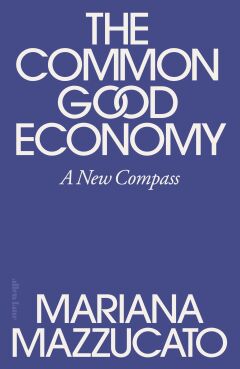
Review of The Common Good Economy: A New Compass by Mariana Mazzucato
Reviewed by David Towell
I am writing this review on the 20th July, the day the UK changed its Prime Minister for the sixth time in 10 years. Indeed, I have just heard Andy Burnham making his first speech outside 10 Downing Street in which he promises a new approach to political and economic leadership that puts government in the driving seat for fundamental change and decentralises power so as to involve ordinary people in efforts to improve the quality of life in every locality.
This book is for him. Mariana Mazzucato is a Professor at University College, London and an activist economist with a particular interest in reshaping the direction and processes of government to better deliver the common good. She has worked locally with leaders in places as diverse as Camden and Barbados and also accepted roles in global initiatives, for example, to advance Health for All.
She summarises the thrust of her book as follows:
“The common good is achievable....It is a practical, measurable and governable project - if we choose to build the spaces, re-imagine the institutions, design the metrics and invest in the capabilities to make it real. In the decisive years ahead, it can form our collective ambition: shaping economies that are sustainable, inclusive and properly democratic, governed by the values and vision of the people they exist to serve.”
Her starting point is the failure of neo-classical economics in a globalised world. Two inter-related myths inform both public policy and much economic commentary: one is that Capitalism plus markets deliver what individuals want. The other is that in this context, the role of government is residual: essentially stepping in to correct market failures. In the age of the global mega-corporations where the super rich can buy the governments they want, this is clearly nonsense, however much we may admire Adam Smith's 'invisible hand'.
Rather, Mazzucato argues that we need government and its partners in business and civil society to proactively build an economy driven by missions that serve people and planet. She offers the Compass as a tool for designing and evaluating these missions at all levels. Globally I have already mentioned Health for All. She also provides worked examples on tackling the climate crisis and ensuring that artificial intelligence is developed as a collective asset. Locally, she provides several examples, including initiatives to develop 'smart cities', build community spaces and improve school meals.
The Common Good Compass is concerned with identifying collective goals and establishing the means of achieving them.
It has five elements that I try to summarise non-technically here:
Both Professor Mazzucato and the Prime Minister seem to be optimists. All this would be transformational. But, of course, the obstacles are also formidable.
It has recently become common for politicians at the top of government to complain that they are pulling the levers of power but nothing seems to happen, or at least not what they expected! It was great progress in the 19th Century when government established strong bureaucracies to deliver government in mostly stable times but this machinery tended to separate 'policy' from implementation and centralise control rather than disperse it. Developing what in another book Mazzucato calls The Entrepreneurial State would require a fundamental change in culture and quite different capabilities.
Even more radically, developing 'common good' partnerships with the private sector would require financial institutions and other businesses to make enriching shareholders secondary to their role in collective value creation, jointly with government, workers and consumers.
And while we know that under the right conditions, communities can mobilise to play their part in co-production, the right conditions include that public leaders treat citizens as genuine partners, trust grows through extensive experience and local government invests in building community infrastructure.
If Andy Burnham is to survive longer than his recent predecessors, his government needs to both demonstrate early progress and set in train a long-term agenda for national renewal. This Compass is not the whole story but one good place to start.
The publisher is Allen Lane. The Common Good Economy © Mariana Mazzucato 2026
The Common Good Economy Review © David Towell 2026
community, politics, Sustainability, England, Northern Ireland, Scotland, Wales, Reviews