Henry Tam outlines how the essential skills of citizenship can be developed so that everyone can be involved.
Author: Henry Tam
In social structures – schools, associations, businesses, public service providers, governments – those in charge are often regarded as distinct in being the rule givers, while others are assigned the role of complying with those rules. But as citizens, we should be both shapers and upholders of rules. We are meant to carry out these inter-connected roles as a group of cooperative problem-solvers – to achieve more in terms of formulating shared objectives, setting suitable rules and procedures, and working together for common goals.
However, in order to cooperate effectively as problem-solvers, citizens must in practice be able to engage with political issues, affect corporate policies, and have a real say about how anyone entrusted with authority over them are to act - in an informed, deliberative, and influential manner. At this point we get the all too familiar objections to empowering citizens to do just that. Those in charge, we are told, must be free to ‘do their job’, and should not be slowed down or worse, blocked by the ‘ignorant masses’. People allegedly lack the skills, interests, or patience to join in problem-solving, and prefer to leave it to those in charge to sort things out.
But if history has taught us anything, it is that at every level of society, in any form of institution, whenever decisions are left to a powerful few who can brush aside the concerns and observations of others, egos inflate, errors persist, and exploitations deepen. By contrast, outcomes are invariably better when the common interest is institutionally prioritised over personal greed or ambition; assumptions and assessments are open to objective checks and enquiries; and power is shared so that decision-making is based on the critical input of those affected.
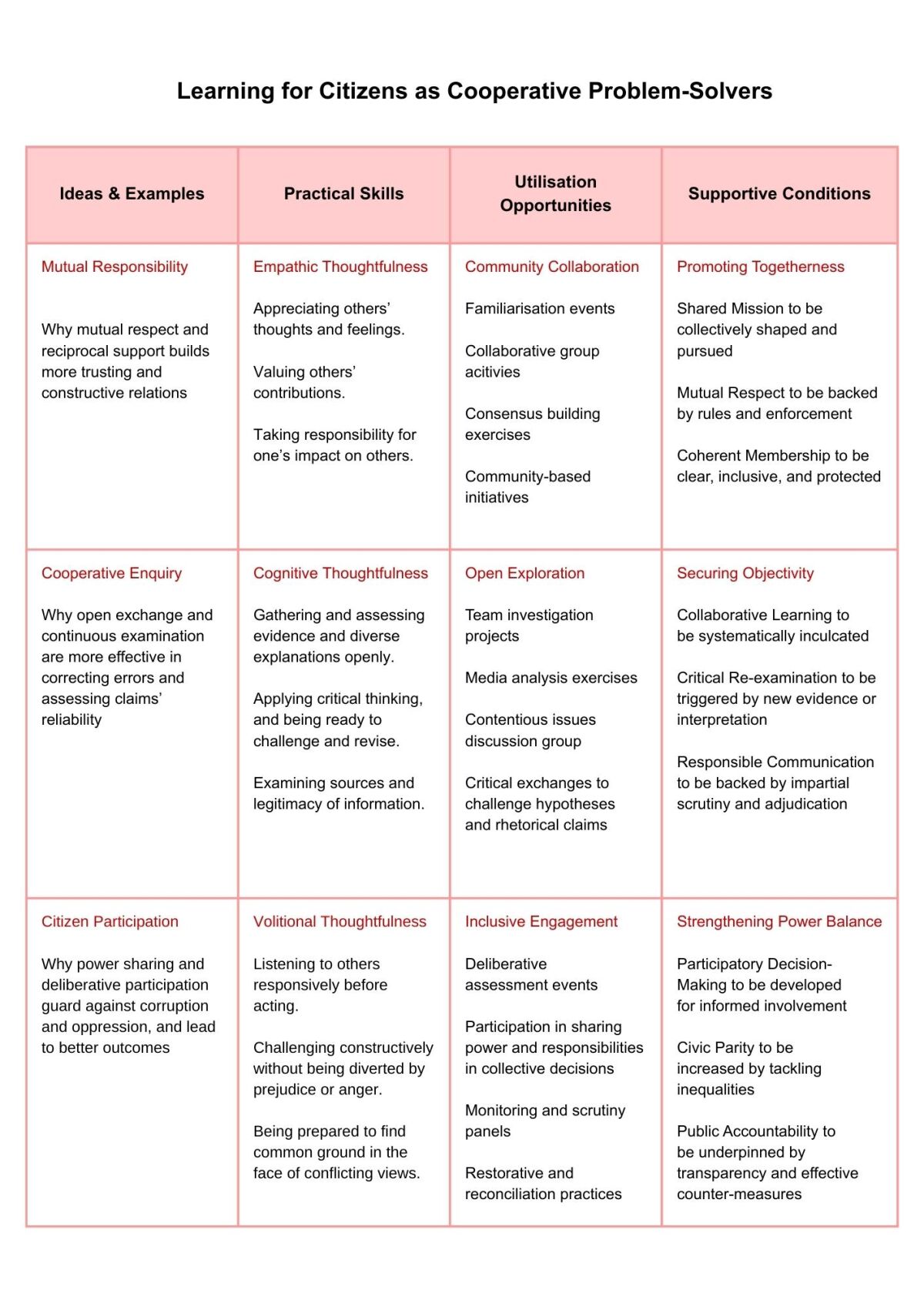
To acknowledge that people need to develop their capability to function as citizens is to recognise that more, not less, educative support is required. This support should encompass four aspects of learning:
These can be summarised in the following table (for further reference, see the Note at the end of the article):
The scope and depth of the educative support needed for the development of citizens call for concerted efforts to improve on current learning provisions. The UK government’s announcement in 2025 to extend and strengthen citizenship education in schools is welcome. But it will require a substantial rise in the number of well trained teachers with the relevant understanding and skills to have the necessary impact (see this report by Hans Svennevig and colleagues: Votes at 16: the role of Citizenship education). And it needs to go beyond schools. From neighbourhood organisations and universities to businesses and government institutions at all levels, there should be developmental support for everyone involved to raise their appreciation and competence in facilitating and engaging in cooperative problem-solving (see Learning for Democracy by Titus Alexander on the importance of wider learning for democracy).
Citizen Learning – designed to enhance our individual and collective capability for cooperative problem-solving – holds the key to not only better performance by every kind of organisation, but also to people having a greater sense of self-esteem and efficacy, and, above all, to a well-functioning society. Groups such as the Association for Citizenship Teaching, the Take Part Network, Neighbourhood Democracy, and others involved in improving the understanding, skills, and conditions for effective citizen action, have a common interest in raising the profile of their work, and should explore making a joint case to expand their offers across society. Students, teachers, managers, workers, politicians, public servants, community activists, would all benefit greatly from citizen learning that enables them to cooperate with others in solving the problems they face, and advancing their common interests.
Note — more information relating to the key aspects set out in the Learning for Citizens as Cooperative Problem-Solvers table above can be found in the following publications:
Discover more about our Communitarian Forum here.
The publisher is Citizen Network. Citizens as Cooperative Problem-Solvers © Henry Tam 2026.
Communitarian Forum, community, politics, social justice, England, Article