People with intellectual disabilities explore the meaning of citizenship and how to achieve it in Slovakia.
Author: Lucia Cangárová
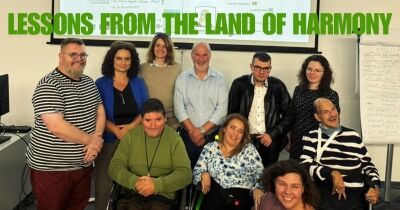
The Independent Life 2025 - Keys to Citizenship conference, held in Bratislava, on 7 October 2025, created a space for a substantive discussion about what it means for people with disabilities to live as full citizens.
Its central contribution was to move citizenship away from abstract language and into everyday life: where a person lives, who decides, how support is organised, whether relationships are respected, and whether people are recognised as equal members of their communities.
The proceedings show that citizenship was understood not simply as a legal status, but as a lived reality. For people with disabilities, this means the possibility of living with dignity, making decisions, being taken seriously, and participating in society as equals. Ordinary situations - travelling, communicating with institutions, managing money, forming relationships, thinking about work, friendship and marriage - were presented as places where citizenship is either made real or quietly denied.
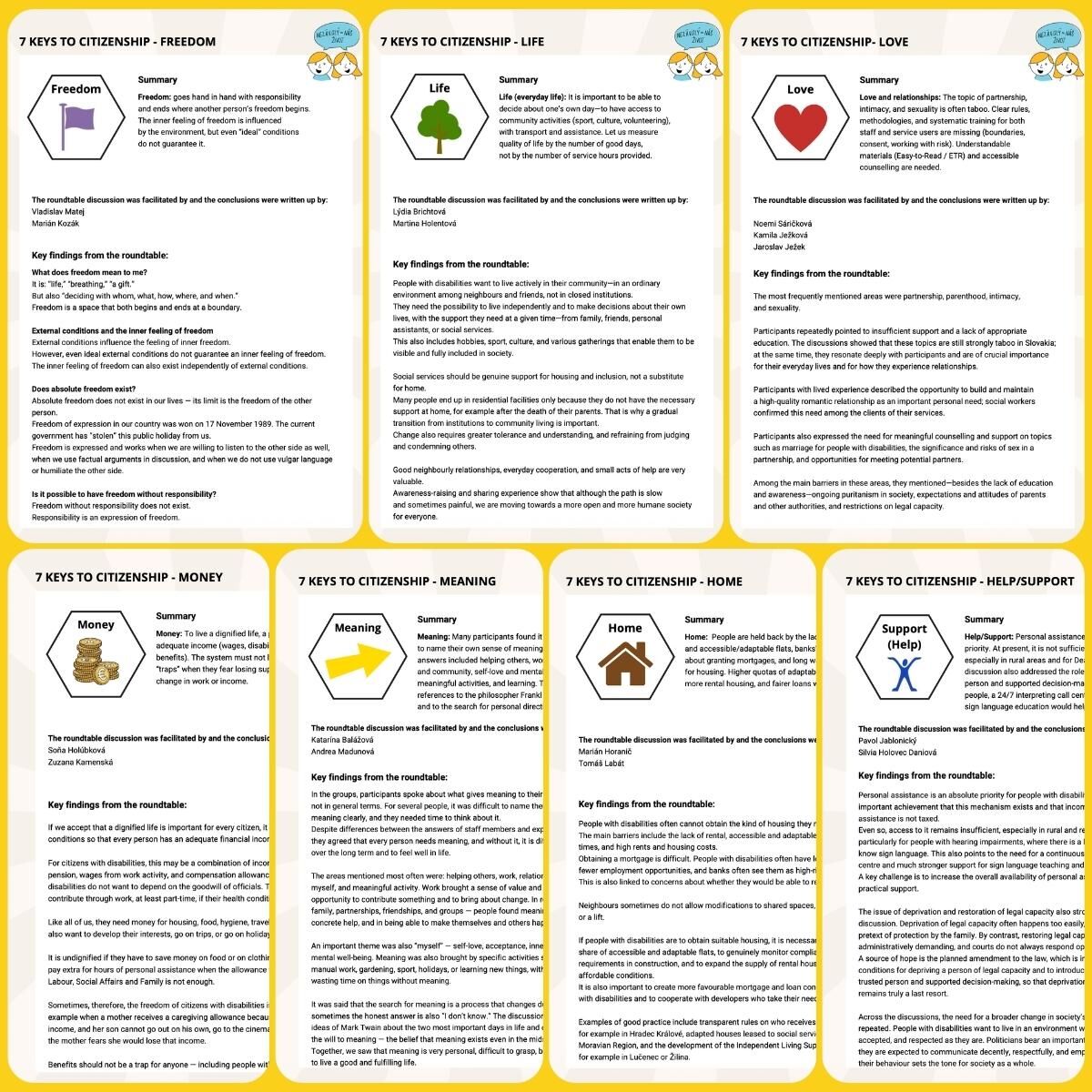
A central reference point for the whole conference was Simon Duffy’s keynote on the Seven Keys to Citizenship. His framework - Meaning, Freedom, Money, Help, Home, Life in Community and Love - gave participants a clear and accessible language for naming what people need to live a good life. Citizenship, in this understanding, is not about being placed in a category or simply having the correct documents. It is about equality, belonging, freedom, support, contribution and connection.
One of the strongest themes of the conference was that participation must be lived, not merely declared. Lucia Cangárová’s contribution on participation as “lived citizenship” emphasised that formal rights are not enough if people remain excluded from decisions about their own lives. Institutional routines, paternalistic cultures and top-down decision-making can preserve the appearance of participation while denying its substance. Participation therefore becomes a test of power: who decides, who is heard, who has influence, and who is still treated as an object of care rather than as a citizen.
The round-table discussions translated this framework into concrete Slovak realities. In the discussion on Meaning, participants reflected on what gives their lives purpose. Many found this difficult to name, which itself became an important insight. Meaning was connected with helping others, work, relationships, community, self-acceptance, mental wellbeing, hobbies, learning and ordinary purposeful activity. The discussion recognised that meaning changes over time, and that not knowing yet can also be an honest and legitimate answer.
The discussion on Freedom linked choice with responsibility. Participants described freedom as life, breath and a gift, but also as the ability to decide with whom, what, how, where and when. Freedom was not understood as independence without others, but as a civic and relational condition: the ability to choose, to be respected, to listen, and to take responsibility for one’s decisions.
The theme of Money made visible how economic insecurity restricts citizenship. People with disabilities need adequate income for the same reasons as everyone else: housing, food, hygiene, travel, clothing, health needs, hobbies and leisure. The proceedings also identify a structural problem: benefits and contributions can become traps when people fear losing essential support because of work, personal assistance arrangements or family income. In this sense, money is not only an economic issue. It is a question of power, choice and practical freedom.
The round table on Help and Support identified personal assistance as an absolute priority. Slovakia has achieved an important foundation by establishing personal assistance as an instrument of support, but access remains inadequate, especially in rural and remote areas and for Deaf people, where there is a shortage of assistants and interpreters using sign language. Participants also pointed to the need for a 24/7 interpreting call centre, stronger education in sign language and better access to supported decision-making. The discussion underlined that help should expand dignity and freedom, not become a mechanism of control.
The topic of Home was explored both through Zuzana Čerešňová’s presentation and through the round-table discussion. Home was defined not as a room, building or place, but as a place of safety, privacy, belonging and control. A good home allows a person to decide how they live, with whom they live and how their own space is shaped. The presentation linked home to accessibility and universal design, while the discussion exposed practical barriers: too few accessible or adaptable rental flats, long waiting lists, high housing costs, difficulty accessing mortgages and insufficient enforcement of accessibility requirements in construction.
The discussion on Life and Community shifted attention from services to ordinary life. Participants were clear that people do not want to spend their lives inside systems. They want to live in the community, among neighbours and friends, with access to culture, sport, volunteering, leisure, work, transport and assistance. One of the strongest insights was that quality of life should be measured by the number of good days a person experiences, not merely by the number of service hours delivered.
The most courageous discussion may have been the one on Love. The proceedings show that partnership, intimacy, sexuality, parenthood and relationships remain highly taboo in Slovak social services, despite being central to people’s lives. Participants called for clearer rules, practical methodologies, accessible easy-to-read materials, counselling, and systematic education for both staff and service users on boundaries, consent, risk and family life. The discussion confirmed that love is not a sentimental addition to citizenship; it is part of human dignity, adulthood, belonging and recognition.
Taken together, the conference outcomes point to a demanding but coherent agenda for Slovakia.
The recommendations are practical:
The proceedings repeatedly return to the same standard: does the system increase people’s real power to decide, belong, contribute and be loved?
An important feature of the conference was that people with lived experience were not positioned only as recipients of support. Several participants took on the role of experts by experience, asked questions, led conversations and presented conclusions.
In this way, citizenship was not only discussed; it was practised. The conference created a community space in which people could speak, listen, disagree, reflect and be recognised as contributors to a shared civic conversation.
Looking ahead, Independent Life 2026 will continue this work under the theme “Keys to Citizenship - Lived Stories.”
If the 2025 conference offered a shared framework, the 2026 conference will bring that framework closer to the texture of real lives: stories of people claiming home, love, freedom, support, money, purpose and community in practice.
The keynote speakers will be Fionn and Jonathan Angus from Ireland, and possibly colleagues from VID Hogskole, Savanger Campus from Norway. Their contribution promises to deepen the dialogue opened in 2025 and to continue the movement from principles towards lived citizenship.
The publisher is Citizen Network. Reflections: Independent Life Conference 2025 © Lucia Cangárová 2026.
Inclusion, intellectual disabilities, Keys to Citizenship, social justice, Slovakia, Paper