An inspiring example of how inclusion can become the natural work of a whole community.
Author: Simon Duffy
One of the highlights of my recent visit to Slovakia was meeting Soňa Holubková and some of her many allies in the Northern city of Žilina. Their work is an inspiring example of what we’re currently describing as Neighbourhoods of Care (until someone finds a better term).
It is work that reminds me, in spirit, although many details are different, of the work of many of our allies in Madrid, Doncaster, Whitley Bay, Wigan and Cincinnati. I am sure that there are many other places too, and part of our work is now to share these examples in ways that help us understand the deeper emerging pattern or the old truths (truths that are still vibrant in many places around the world, but have been forgotten in many so-called developed countries).
How to explain what I saw?
Perhaps it is worth thinking about this as a new path towards a world without institutional care. It is perhaps compatible with some of the old paths, but it seems to me that understanding it through its differences may help us understand its great value.
The process of urbanisation, industrialisation and the increased centralisation of power within the state has gone hand-in-hand with the process of institutionalisation. People lost their rights to access common land, forests and to grow food of their own. They were no longer allowed to look after themselves or those they love. They were pushed off the land and lost the community structures where people—generally—accept a shared responsibility for taking care of each other.
Instead, people were offered a pitiful amount of money to work in structures that ate up most of their time, meaning they increasingly lost their ability to take care of their families or their neighbours. If they could not work, they were placed in workhouses, poorhouses, institutions or other services—services that are designed to offer a combination of minimal care and social stigma—so that people would not be encouraged to escape the economic system in order to join the care system. Over time, working-class organisations led to a combination of greater democracy and welfare systems that did something to compensate people for these initial injustices. However, as we see today, both democracy and the welfare settlements are currently in decline.
All of this means that care systems will, at best, be only adequate. However, in practice, care systems are often much worse than adequate, and in the worst cases, institutional care has been the testing ground for eugenics, euthanasia and extermination. We might call this approximately 200-year process of capture, exclusion and undignified care institutionalisation.
In the 1960s, a process of deinstitutionalisation began. It has been driven by disabled people, families, professionals and even by random citizens who were affronted by all the injustices bundled together by the institution. The normal pattern of deinstitutionalisation has been to try to imagine how we might exchange the old system for a new, better system that undoes the harm of the old system. Sometimes this is called community-based services.
The process of deinstitutionalisation has been challenging, successful and very slow. It varies in quality between two extremes:
Minimal deinstitutionalisation is the exchange of large institutional services for somewhat smaller institutional services that are physically adjacent to mainstream community life: hostels, residential care services, day services, domiciliary care services, etc.
Maximal deinstitutionalisation usually involves the development of systems that support people to be full citizens, not recipients of services and in practice it requires the development of an infrastructure of supports and economic entitlements: independent living services, personalised supports, direct payments and personal budgets.
My life, and the lives of many of my friends, has been very focused on achieving maximal deinstitutionalisation.
However, if we keep in mind the causes of institutionalisation, we might also notice an important limitation to our methods. We are not providing the deeper economic securities that enable everyone to take care of each other, and we are not changing the expectation that disabled people somehow belong to the state. Moreover, we are not working with the community; we are creating things in the community, but that’s not quite the same thing.
The service system—even if equipped with personal budgets, great values and all the best innovations—is still an effective, if somewhat more invisible institution. This explains why, even when we make progress on self-directed support or independent living, we often feel the ground changing under our feet as the state changes the rules, tightens the criteria, tweaks the bureaucracy or shifts its priorities. We are still in the Matrix.
But there is another way, and Soňa Holubková and the Harmony Land Foundation show us that way.
Soňa was working in the institution when, in 1990, after the Velvet Revolution and the emergence of a free Slovakia, she started to explore an alternative to the institution. But she started, not with the institution, but with the community. She describes herself as “lazy”, but she is clearly not lazy. But what she means is that if she had taken the view that it was her job to ‘take care’ of people in the community, then she would have never been able to help the community learn that we can all take care of each other. From an economic point of view, Soňa made the profound assumption that the community was already richer in care, relationships, common interests, social structures, and practical resources than she or any institutional structure could ever be.
One of her earliest interventions, in 1990, was to create a theatre event in the city where people with intellectual disabilities put on a play. Over 25 years, this grew into a huge festival of fun, scattered across the whole city, with thousands of volunteers from schools, colleges, many other institutions and the community. Each year, there would be a different theme (I would have loved to see the Shakespeare-themed festival!), and the process of creating the festival then generated a multiplicity of relationships and further actions. Robert Blasko, who is another leading activist and creator of the creative arts space (The Station) was one of the children who joined in and discovered the joy of inclusion. As he said:
“It was great to get time off school, and have fun.”
So, Soňa was also liberating children from the limits of the education system to discover the possibilities inherent in the community.
This work prepared the ground for the ongoing work of support and inclusion. The festivals were primary because they created lots of random and beautiful connections, and they demonstrated that people could be present as a creative force, not as needy people. Allowing people the chance to create things, to fail at things, to shape things themselves became a critical force. As Roberto also noted:
“There was space for indecision.”
The Harmony Land Foundation also put down roots in Žilina by buying a building that they could call their own. The building was partly gifted by an ally who understood what was important about the work. This base provides a practical space for gathering, organising, playing and offering some people a place to stay as they prepare for a more independent life.
Of course, problems happen, and one day there was a fire in one of the flats. So what happened? Well, multiple neighbours called the Fire Brigade and worked to make sure everyone was safe. When it came to repairing the damage, the service system said it couldn’t help. But the neighbours had, on their own initiative, already organised to pay for the repairs.
What does support look like if we put community first? Well, a lot of it seems to be about good listening, creating solutions from what is already available and connecting people to the right people for them. Soňa stressed the importance of reaching out to the real experts: the professional musicians, the music producers or the theatre directors—in whatever field, go to the top.
Jan, a passionate supporter of Žilina’s football team, has built a life out of his passion. He is at the heart of the football community, he knows everyone, he attends everything, and the hardcore supporters of the team put him at the heart of things (including visits to the bar). The team have now given him a life-long ticket to all their matches. Jan brings passion, time and a wonderful personality, and these are a gift to the football community. Not everyone can stay as connected as he can, but through him, everyone can connect to the team they love.
I asked: What are the seeds of change?
Jan said: The people are the seeds.
I think this means that we must be careful to get things in the right order. It is people, as people, not as labels, not as service users, not as budget-holders or owners of person-centred plans, who must come first. Other things may help, or they may not, but the relationships we create by seeking to connect people together are critical.
My friend Bod Rhodes calls this “lives through friends”.
Today, a very exciting development is beginning in Žilina: the Harmony Land Foundation has now got a small fund to provide flexible support to enable more people to help create independent lives. This resource is not controlled by the central government, regional government or local government; it’s controlled by the Foundation. It will be used carefully—it is only 200 hours of support. But this will strengthen the Foundation’s ability to help more people.
Over the past 35 years, the Foundation has been working with many people and families to help them construct low-cost and no-cost solutions for their independent living and development. It works primarily through the process of Good Help outlined by John O’Brien (see figure 1). However, money is very tight, and there are very few resources orientated at the community, so this experiment in shifting resources into the community—at the level of the community—is very important.
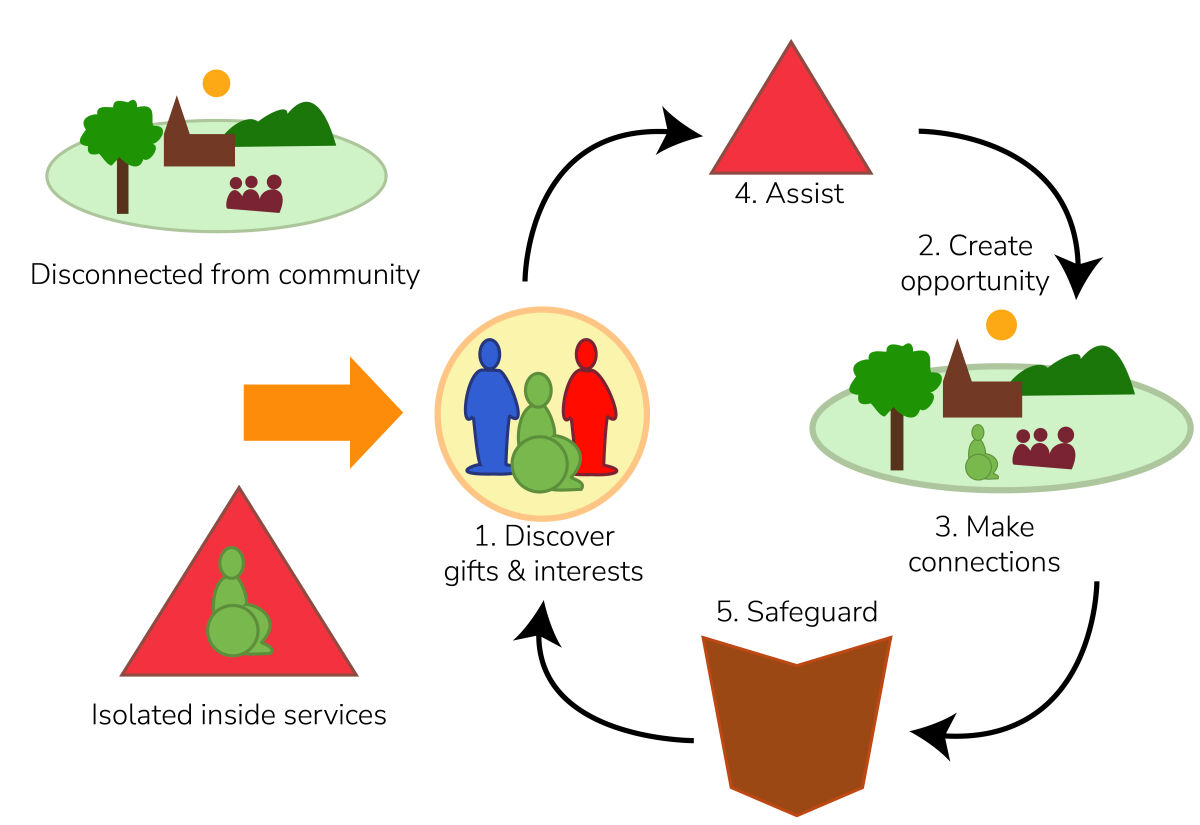
FIGURE 1: The Basic Tasks
In practice, one of the critical issues for the development of Neighbourhoods of Care will be to explore how best to manage limited resources so that we are adding to the fertility of the community, not destroying its fertility. We have seen too many examples of how funded service solutions actually switch off community actions. This has the effect of not only costing more money but, more importantly, it reduces the likelihood of good relationships emerging.
I am struck by the similarity between our work in care and what we are learning from regenerative farmers: fertilisers can be dangerous, and natural fertility comes from the work of the plants in the soil. Recycle and compost, but avoid importing additional resources if you can. Keep the cycle of planting, growth, harvest and recycling as tight as possible.
Of course, the real resource is never money. It is people and their desire “to be useful to someone.”
I am unable to capture all of the wonderful stories, examples and flashes of wisdom Soňa and her friend shared. But I was thankful for the chance to also share my own thinking on how we nurture Neighbourhoods of Care. This still feels like a work in progress, and I’m hoping I can learn more from all my friends over the coming years, but the theoretical model I’ve developed so far has this logic.
My overarching metaphor these days wobbles between the ecological and the civic (between my garden and Ancient Athens), and so I apologise for what will become a mixed metaphor, yet I feel both aspects are important. My initial assumption is that we must step back from operational models or systems with an industrial logic - input-process-output. In my work on personal budgets the idea of the 7 steps of self-directed support was perhaps useful because it gave people an operating logic: (a) people can imagine a basic pathway to getting control of their life and their support and (b) professionals could reorientate themselves to a different kind of relationship, one that assumed the person, not they, had agency. However, all of this still assumes that the basic framework is constrained by a transactional relationship between the citizen and the state.
However, in a community, we cannot treat this transactional relationship primarily. As our friends in the Camerado movement would say: “There should be no fixing.” If we want to meet others as equals, then we need to create spaces suitable for equality.
Fortunately, we do have an example of what a space for equals might include: the Athenian Agora. The Athenian Agora was a structured open space. There were clear places to go and do specific things (doing your shopping or acting as a juror in the courts), but there was also plenty of bumping spaces, open spaces where you might reconnect with people you knew or meet new people. In fact, all the more functional spaces were built around a large open space which could be used to organise everyone, including pulling together the army if necessary.
[Historical footnote: When the Romans took over Athens and destroyed democracy, they built a giant building in the middle of the Agora, destroying this open space. Think about this today. Is the modern state a tool of local people or is it like the Roman State, an overwhelming colonial force?]
All of this shared public space was sacred, held in common for the wellbeing of the City. It could not be controlled or owned by any private person or body. It was a citizen space, and it was controlled by citizens. Today, we may not be able to clear a vast public physical space in the heart of our villages, towns and cities, but perhaps we can imagine creating multiple public spaces (including online spaces).
In gardening or farming, we also need to think spatially rather than mechanically. In the garden, we create different spaces, which have different functions, and we pay attention to the flow and function of these spaces. The garden is created by the combination of the space, the soil, seeds, plants, rocks, paths, insects, birds, rain and the sun. It is not one thing. It cannot be reduced to a process. It is a place where we work, where we coexist in harmony with nature and where our hearts are nourished. In developing Neighbourhood Care, I’m currently working with a framework that has 9 spaces:
Open Space - a central accessible space to connect or just to be.
In the quadrants, 4 functional spaces:
And 4 in-between spaces:
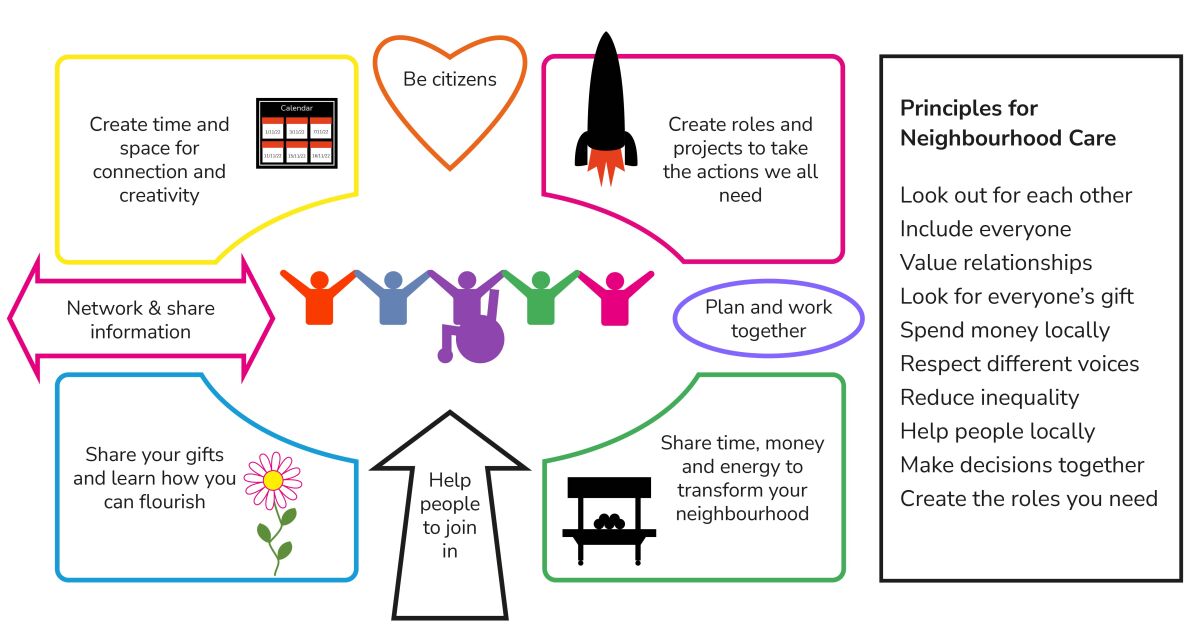
FIGURE 2 - The Ecology of Neighbourhoods of Care
At this stage, my hypothesis is that the development of Neighbourhood Care will involve at least 3 critical strategies for sustainability:
Have faith and build the structures - Behave as if you are laying the groundwork for the neighbourhood you want to live in, and make sure that your actions open up spaces and create future opportunities for natural fertility.
Steal stuff - Take what you can from the old, dead system and try to see how you can recycle it into sustainable use for the new fertile system, but make sure you are not captured by the old rules or bring in resources that poison the land.
Be lazy and don’t decide too much - Behave as if the work of care is citizen work where everyone has responsibility, and make sure others can have fun struggling, failing, succeeding and learning.
These three strategies may generate sustainable value.
We can certainly see this kind of thinking at work in Žilina. The enormous festival that Soňa developed over 25 years was the creation of a Celebration Space, but it started with a few people from the institution setting up camp in an unused theatre for a few days. The festival then set the scene for recognition of the Foundation as people who cared, people you could trust, and this helped the establishment of a building where people could go, be heard and start to help themselves figure out solutions. It became a Learning Space. Resources that came with too many strings were ignored, but gifts from the community flowed in as people understood the value that was being created within the community. New Action Spaces, like The Station, emerged as others were inspired and realised they could build new spaces for a better future, too. The whole story is one of organic and sustainable change… and it is ongoing and changing now.
I hope my characterisation does some justice to the beauty and joy in the work of Soňa and the Foundation. It was wonderful just to get some small sense of its power.
Ontology is a fancy Greek word, but I like it. It is the study of the essential things and their relationships. Institutionalisation and deinstitutionalisation works according to a shared ontology: services, money, regulations, governance and control. But Soňa points to a different and more primary ontology: citizens, families, forms of love, neighbours and neighbourhoods. To shift our behaviour and move beyond deinstitutionalisation, we will have to take this new ontology much more seriously. When we use an expression like ‘care in the community’, we need to hear it echo back: ‘but how do we care for our community?’
The publisher is Citizen Network. Inclusion in Žilina © Simon Duffy 2026.
community, Deinstitutionalisation, Inclusion, Neighbourhood Care, social care, England, Slovakia, Article