Jason Leman shares the March 2026 edition of our Neighbourhood Democracy newsletter.
News | 30.03.26
Sign up here to receive this regular newsletter by email.
This update is about Pride in Place and the idea of neighbourhood renewal. Across the country there is frantic recruitment to the Pride In Place neighbourhood boards amidst a scramble to meet deadlines. As much as the funding for neighbourhoods is excellent, it is also selective and neglects things that we know are essential to renewing pride in our places. This is a roundup of recent critique, comment and resources about Pride In Place.
Renewal needs infrastructure |
|
"With less than 12 months to build relationships, develop governance structures and agree objectives, this timeline is ambitious and would be challenging even for a highly engaged, empowered and trusting community. ... The fundamental ingredients of community-led renewal — community capacity, local leaders and trusted community anchors — must be strengthened and supported across all selected neighbourhoods." |
|
This paper by Yasmin Ibison and Scot Hunter of the Joseph Rowntree Foundation is an excellent analysis of the gaps in Pride In Place and how successful community building needs connections and activity in place. |
|
These arguments echo those of others, such as Locality, who are calling for community anchor organisations to be supported to grow in every neighbourhood. |
|
|
Renewal needs involvement |
|
“The risk is that new Pride in Places boards, struggling to cope with a decade of falling local authority budgets and deteriorating high streets will rush to plug some obvious gaps without taking on deeper ways of working … Can we avoid replicating ‘quick win’ solutions, which have not previously worked? Or, that allow funding to flow straight back out of those communities, as recognised in too many regeneration programmes of the past” |
|
This blog from Jez Hall of Shared Futures CIC advocates participatory budgeting as an essential tool of Pride In Place. Participatory budgeting can ask people to bring ideas for what their area needs, help them develop those ideas into solid proposals, and involve local people in directly deciding which proposals should get money. There is a free online workshop on this topic hosted by Shared Futures on Tuesday March 17th, 12 midday to 1pm. It’s aimed at elected members, local authority officers, grant makers and community workers. |
|
The risk of funding from flowing back out of communities reflects the concerns of CLES, who argue the Pride In Place funding should be seen as a kind of community wealth building. |
|
|
Renewal needs inclusion |
|
As much as people in Pride In Place areas could be included, it has a built-in exclusivity. Funding is showered on some neighbourhoods while others are missing out. |
|
|
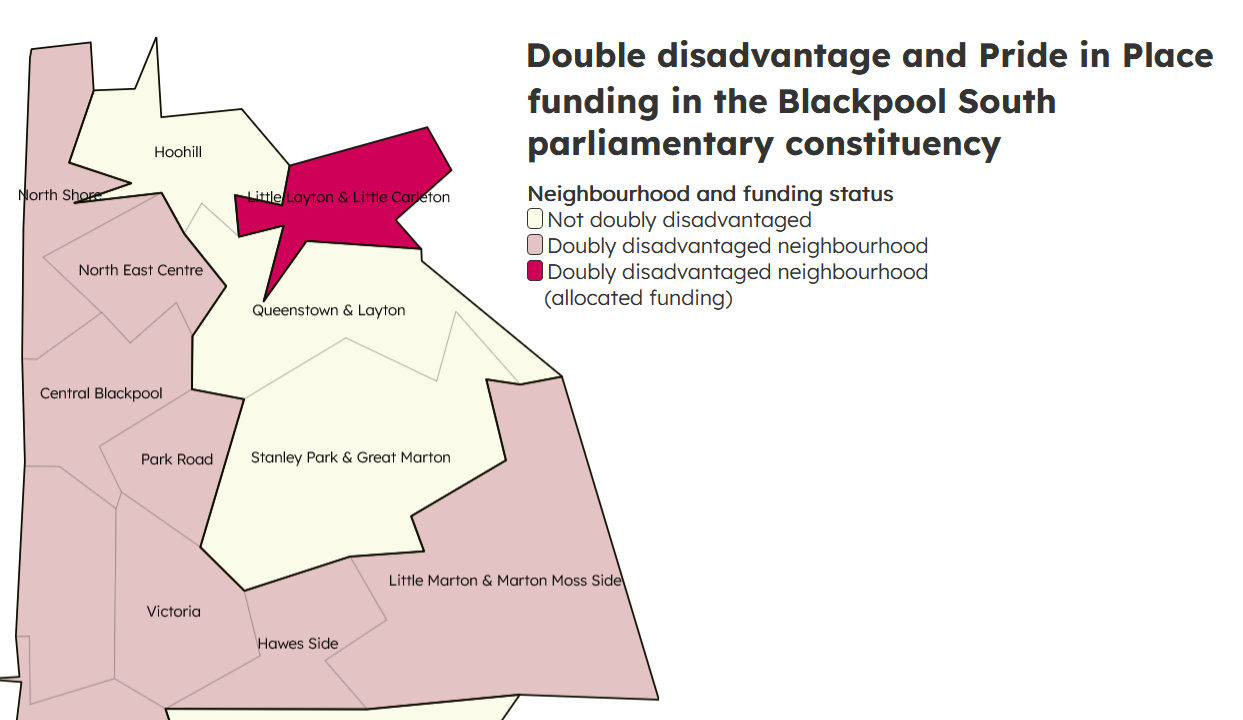
This image is of a Pride In Place neighbourhood in Blackpool. One neighbourhood (coloured in dark red) has gained £20million of funding while other neighbourhoods in the same area with similar levels of challenge (in light red) haven’t received anything through the programme.
|
|
The Citizen Network analysis of funding allocation to an area in Sheffield came to similar conclusions as the JRF report - Pride In Place funding needs not to be tied too closely to arbitrary statistical areas. |
|
|
Renewal needs innovation |
|
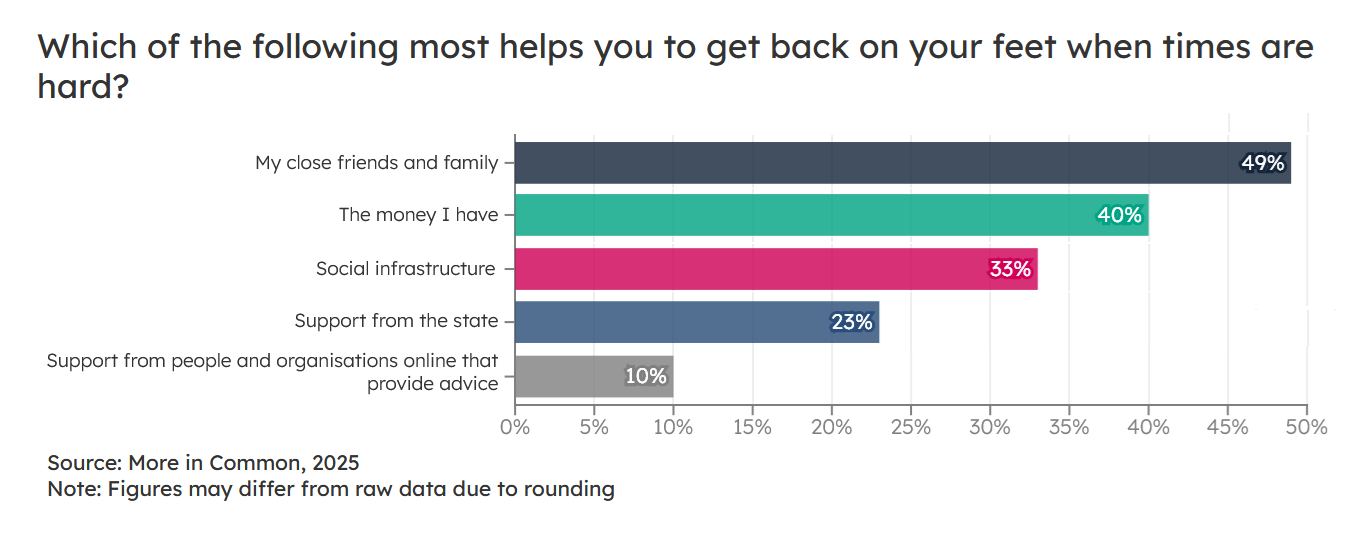
The No Short Cuts report from ICON is clear that more investment than the Pride In Place programme is needed to really change the fortunes of the UK. A survey, cited in the JRF blog, shows us the shape of the challenge. |
|
|
When people are struggling with the cost of living then, regardless of Pride in Place funding, life will remain difficult (as highlighted in this Local Economic Development podcast). When investment in social infrastructure is piecemeal then people in some areas will find paths towards becoming connected while in other areas people will remain isolated and adrift. The ICON report also argues that too many investment areas would overwhelm the capacity of central Government and local bodies to coordinate funding. An alternative viewpoint is that if the funding was given on trust to local organisations with flexibility over time, and was open to more innovation, then it could sustainably go to many more areas. This isn’t a new idea and Demos summarised it well in their Liberated Public Services model, arguing for programmes where: |
|
“Professionals are empowered to experiment with new ways of working, adapting practice to shape local and personal need; citizens are encouraged to bring their whole selves to services; communities and social networks are enlisted as active partners in delivery.” |
|
This isn’t the only innovation needed for neighbourhood renewal. From how money is shared to how citizens are supported to be active participants in shaping their own lives to the creation of Neighbourhoods of Care, broader change is needed. For all of the frenetic activity around Pride In Place, it can only ever be a small part of renewal. |
|
Hope this update is of interest and, as ever, if you have news or ideas to share then please get in touch. Till next time, hope all goes well. Best wishes, Jason Jason Leman |
|
|
Thanks to Ester Ortega for the wonderful illustration. |