German and English town councils represent the tier of local government closest to the community.
Author: Gavin Barker
In Germany, like other federalist systems, municipalities derive their powers from the German constitution, not from the central government. This means central government cannot override municipal autonomy without first amending the constitution – and that is deliberately difficult to do (see annex).
There is no similar democratic guardrail in the UK because we do not have a written codified constitution. Parliament can amend or remove English local government with ease. All that is needed is a simple Parliamentary majority of one. Parliamentary supremacy applies to any law, no matter how fundamental to our wellbeing, and this makes our most important laws and institutions vulnerable to single-party rule based on narrow party-political considerations.
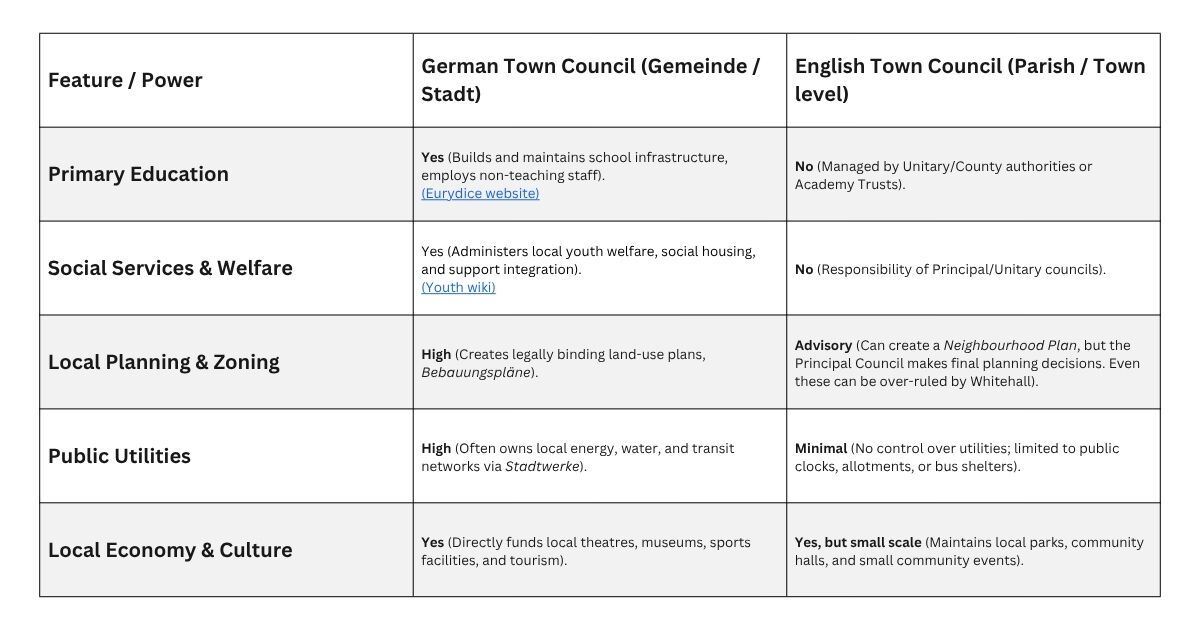
They have no statutory planning authority; their role is purely advisory (a statutory right to be consulted on planning applications) and involves drafting Neighbourhood Plans. These are subject to independent examination and local referendums. Such plans may or may not be adopted by the local authority.
On average, a German municipality covers a population of between 6,690 to 7,400 inhabitants. These have full statutory power to draft and adopt legally binding preparatory land-use plans on which more detailed development plans (Bebauungsplan) are based. They do so under the Federal and State government (the Länder), which must align with the Basic Law. The framework is as follows:
The Federal Framework:
The state (Länder) framework (state building code):
Within those rules, a municipal council decides exactly where the roads, parks, and houses go. If a private developer buys a plot in the designated land area, they cannot simply build whatever they want. They must apply for a building permit (Baugenehmigung). The local building authority compares the developer's architectural drafts directly against the municipal B-Plan, the state regulatory framework, and the federal regulatory framework. If the design complies with all three, the municipality is legally obligated to grant the permit.
A developer cannot challenge the B-Plan in court if they did not submit their objections during the official public participation phase.
English town and parish councils:
There is no municipal control of water and wastewater. The English system has completely decoupled these utility sectors from public control. Instead of income being recycled locally, profits from water and sewerage services go directly to global shareholders.
German municipalities:
In Germany, the delivery of water supply and sewage treatment is dominated by public ownership, which is safeguarded under the constitutional principle of Daseinsvorsorge (public services of general interest). This entrenches political accountability and democratic oversight, ensuring that water management remains responsive to local needs rather than global shareholders.
Public-service legal structures account for 92% of wastewater treatment and 64% of water supply across the country. Municipal ownership is the primary form of public ownership – even for town councils with populations as low as 6,000. Rather than a single uniform model, such ownership operates through a variety of organisational and corporate structures.
The predominant forms of public ownership include:
For urban areas, the most common form of public ownership is the integration of water supply with other public services, such as energy, gas, and local transport. There are two advantages to adopting this model:
Municipalities also have the statutory power to mandate that all local properties connect to and use the public water and sewage systems. This establishes a secure, local public monopoly that guarantees the financial viability of the public utility.
In rural regions and smaller communities, the predominant form of public management is inter-municipal cooperation.
Some municipalities choose to operate their water and sewerage works directly as a department of the local administration with no separate legal personality from the municipality. While historically common, many municipalities have transitioned away from direct in-house departments toward independent municipal enterprises to limit municipal liability.
The difference between constitutionally awarded powers versus powers awarded under ordinary parliamentary legislation may seem like an obscure and technical point, but the difference is vast. The only way an elected government in Germany can override municipal powers is by first amending the Basic Law, and that process is deliberately difficult to do. It requires a formal legislative act passed by a two-thirds majority in both houses of parliament, the Bundestag (lower house) and the Bundesrat (upper house).
Water is viewed as a public heritage that must be protected, prioritising public health and environmental protection over competitive market dynamics. It is protected in Article 28, Paragraph 1 of the Basic Law (The German Constitution), which obliges every elected government to conform to the principles of a "..social state governed by the rule of law…"; in effect, the state has an overarching, permanent duty of welfare and social protection.
While the Basic Law does not list the specific services the state must provide under this principle, federal and regional administrative laws interpret this "social state" requirement as a mandate to guarantee that all citizens have access to the basic services and necessities of life (Daseinsvorsorge). This includes clean water.
While both German and English town councils represent the tier of local government closest to the community, they operate under fundamentally different constitutional, financial, and structural realities. In short, German municipalities, often smaller than Truro, derive their powers from the German Constitution, not from elected central government. Their autonomy cannot be overruled by the centre. This allows them control over planning, water supply and sewerage, energy and more. This paper focuses on planning, water supply and sewerage only.
The publisher is Citizen Network. German Councils vs English Councils © Gavin Barker 2026.
Constitutional Reform, Local Area Coordination, local government, Neighbourhood Democracy, England, Europe, Northern Ireland, Scotland, Wales, Article