Jason Leman shares the July 2026 edition of our Neighbourhood Democracy newsletter.
News | 16.07.26
Sign up here to receive this regular newsletter by email.
The likely next Prime Minister advocates for “Manchesterism”. Sceptics were quick to note that the Manchester model of regional government has played only a supporting role in the city’s success. The city is not exceptional, economically or socially. Indeed, the use of “Manchesterism” may only be a political play for the current mayoral election, bigging up Manchester and all who sail in it. The real question is about the political choices the rhetoric is appealing to. That's the topic of this newsletter.
|
|
|
Welcome to Pickettyville |
|
|
Devolution of power away from London is important because the wealth in London distorts the economy and politics of the UK. London has been shaped by the super-rich: |
|
“This phenomenon is … is an ‘upward’ colonisation by capital that can perhaps best be characterised as the emergence of a plutocratic city in which raw money-power increasingly dictates the social, political and symbolic landscapes … the city becomes a site of active plunder by global capital” |
|
You can listen to an excellent discussion with Caroline Knowles on the often lonely and paranoid multiply-deprived lives of the super-rich on the ratio podcast. |
|
|
Power at the centre |
|
A central part of the plan of Andy Burnham is to devolve money and power away from London to the ‘Mayoral Strategic Authorities’ like the Greater Manchester Combined Authority. There are plenty of ideas about how to do this but one of the big questions is whether those who hold the purse-strings at the centre will let go. |
|
“Burnham points to something known as Total Place – a 2009 Treasury-backed initiative to map all public spending in an area and redraw services around place-based outcomes. … But at the time, with austerity on the horizon, it challenged too many aspects of the Westminster system – hierarchical accountability, rigid Treasury rules, departments protecting their own budgets and short-term funding cycles. It was quietly abandoned.” |
|
Dave Richards and Sam Warner write on the challenge of overturning the orthodoxy at the treasury. |
|
|
Power at the periphery |
|
|
The image of “Manchesterism” relies both on the centre giving away power and the periphery taking it. The risk is that this image fails to capture the detail of what is actually needed to make plans like this work in every place: |
|
“community-level agency, the capacity of residents and civic organisations to shape their own places, is itself spatially unequal, and that top-down policy frameworks frequently fail to account for the granular, neighbourhood-level differences in social capital, institutional trust, and organisational infrastructure that determine whether national aspirations translate into lived experience.” |
|
Rebecca Riley's excellent LPIP blog on Andy Burnham's proposals brings together a wealth of scholarly analysis showing what regional devolution needs in practice. |
|
|
Consider the soil and soul conditions |
|
Emma Bearman of Playful Anywhere, reflects on Burnham’s speech, her own work and who we need to keep in mind as we consider power and how to redistribute it. |
|
“Now we have all agreed that Burnham is our North Star, and we start using a Manchester accent to talk about place and good growth, there will be many pivots. There will be many doubling down on the fact they have been talking about people, place and ‘good growth’ since forever.
"T’was ever thus. We flock to power. We give power, more power. The power becomes everything.
"If you have any power, you have to consider the roots, the soil and soul conditions that mean we have real child poverty in this country. And those children deserve a wonder filled, care-free childhood … if those children are not in our meetings, we must advocate for them. For their childhoods to be free. Of worry and want. And full of possibility” |
|
|
Nourishing the roots |
|
|
What is missing in the current rhetoric is the neighbourhood scale, a “scale that can serve as a powerful arena for change” (as the recent OECD review put it). Miatta Fahnbulleh spoke about this scale of action for Pride in Place: |
|
“The cure for our problems today is in the pit villages, where hands that once took coal from the ground also built welfare halls for their families to make memories. The cure is in the classrooms, where under crumbling roofs, parents put on after-school clubs and summer fetes. The cure is Sunday league football grounds, where the next generation support their town with the same passion as they’d support their nation in the World Cup. This is our alternative to the forces trying to pull us apart. This is our answer to those who feel silenced, ignored and forgotten.” |
|
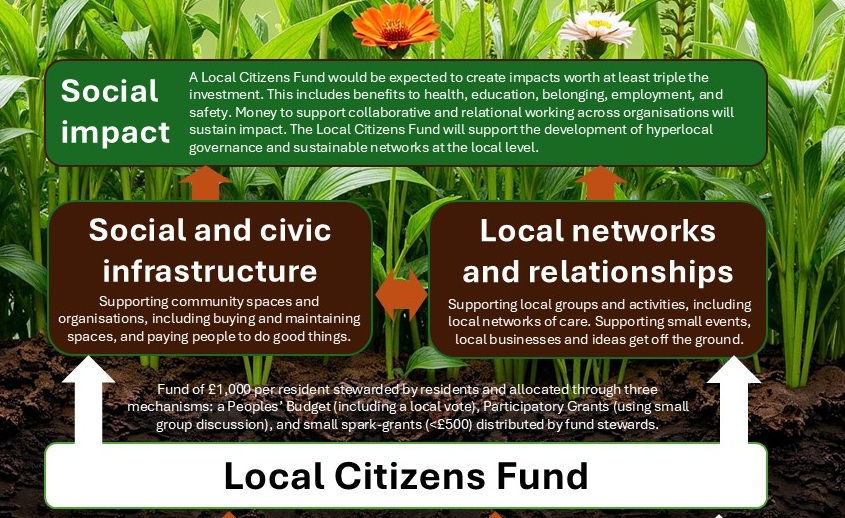
But ‘Pride in Place’ and similar schemes are scattered thinly. How do we get this happening in every place to nourish the roots of hope and possibility? One solution is taxing the wealth of the super-rich (which isn’t making them happy anyway) and sharing with every neighbourhood. You can read more about that idea here: |
|
|
|
Hope your week goes well. Any feedback, ideas, or news to share then please get in touch. Best wishes, Jason Jason Leman |
|
|
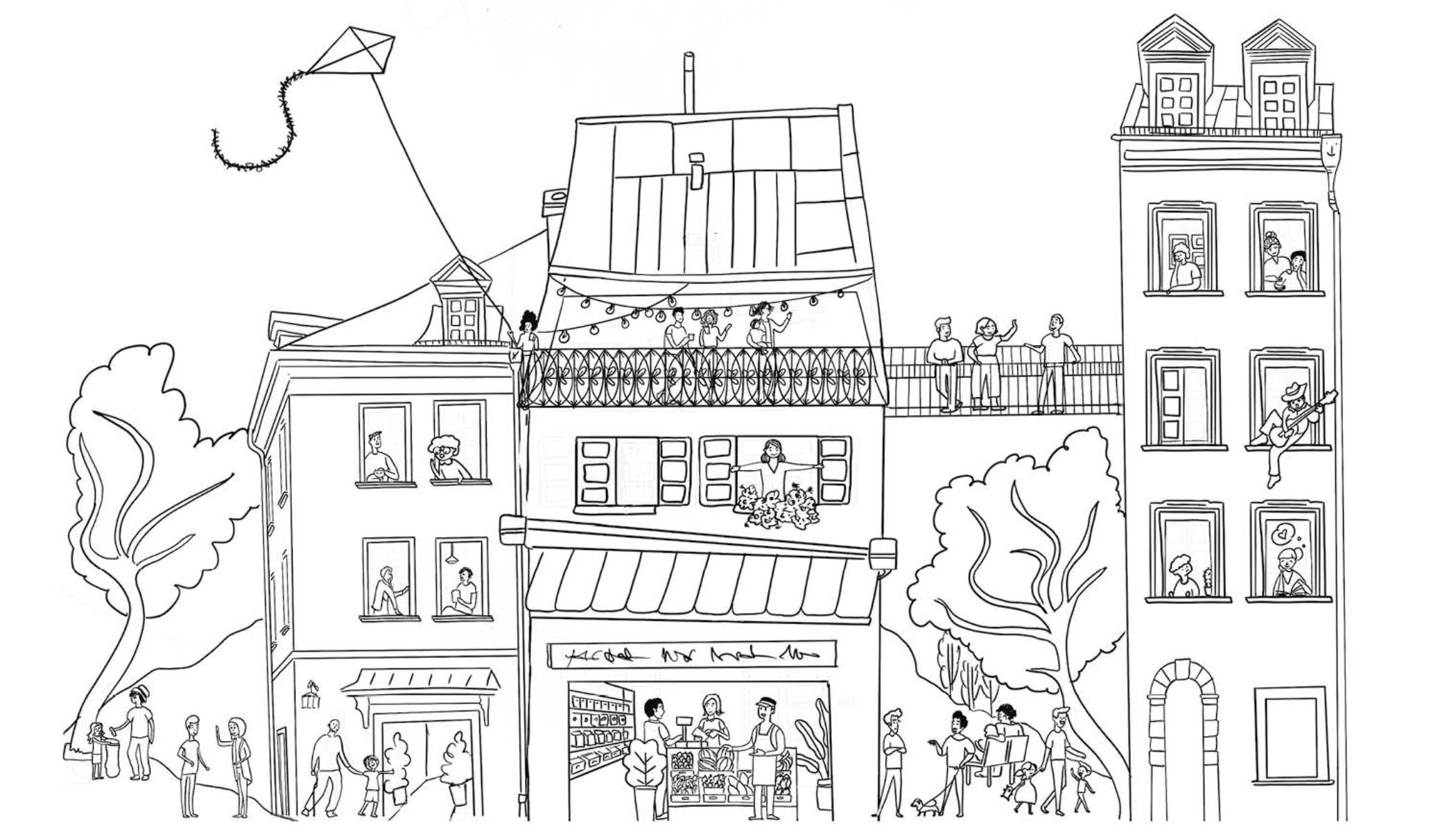
Thanks to Ester Ortega for the wonderful illustration. |